CHURCHES IN BRIEF " "

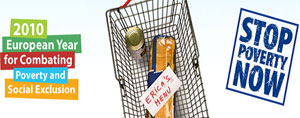
Caritas Europe: appeal to the European Council “We encourage a paradigm shift in which human dignity and integral human development, within environmental boundaries, will enable the poorest and most deprived and marginalized to participate in caring societies and live in equitable and sustainable economies. Caritas Europe calls upon European States to play their role and fulfil their responsibilities in the fight on poverty and marginalization in a changing world”. The appeal of the directors of 49 Caritas organisations in Europe was pronounced during a European Council meeting held in Brussels past May 27-28. During their meeting in Brussels past May 23-24 the Caritas directors highlighted the need to design “a new agenda as an expression of the ongoing commitment to fight poverty and to provide human dignity for every world citizen”. This need is all the more cogent in view of the end of the Millennium Development Goals set in the year 2000 by the United Nation. “Hunger and malnutrition are the most cruel and concrete manifestations of poverty”, said the Caritas director, who called upon the European Union to champion adequate food for all “to make a world without hunger a reality”. Past February Caritas Europe released the findings of the Report on “the impact of the European crisis”, according to which at the end of 2010 23.4% of the EU population ( 115.7million people ) were at risk of poverty or social exclusion in 2010, an increase of nearly 2 million since 2009 and children were at a greater risk of poverty (26.9% EU average). These figures show that “austerity measures, if not accompanied by adequate support and development policies are likely to have an increasingly negative impact on the lives of poor people, and to bring austerity measures, if not accompanied by adequate support and development, policies are likely to have an increasingly negative impact on the lives of poor people, and to lead many other people for the first time to a state of poverty”. In analyzing the crisis that hit many European countries, Caritas Europe denounces that “the response of governments is leading to a vicious circle in different countries: spending cuts, operated with the aim of achieving European goals of debt reduction, are reducing the level of consumption and lead to high social costs, linked to the lack of access to services by a significant portion of the population, plagued by rising unemployment”.France: Catholic schools are necessary On June 1-2 in Parc floral de Vincennes, on the outskirts of Paris, will be held the first national congress of Catholic schools representing nine thousand institutions, one hundred thirty-four thousand teachers, more than two million students. “Enseignement catholique” is the organization in France that brings together the vast majority of Catholic schools under contract with the State. “Do we need Catholic schools?” is the title-question of the meeting. The Congress was prepared in dioceses. During the meetings emerged six themes that will be explored in the two-day event in Paris, namely: to focus on social diversity, to contribute to the new evangelization; to succeed in entering the job market; the promote civic commitment; to participate in ‘animation of the territories; to develop pedagogical creativity. For example, from the diocese of Nantes comes the request for a more outward-looking school, a school marked by sharing whence springs the intention to develop innovative educational projects with the contribution of school boards, municipal representatives and associative networks. The headmasters of the Catholic schools in Nantes proposed to develop pastoral projects that will meet the expectations and families and adopt appropriate timetables. Participants highlighted the importance of increasing public funding. Also the diocese of Angers called for a greater presence of Catholic schools in the area. Past April 18 French bishops adopted the new Statute on Catholic teaching and appointed Pascal Balmand as the new general secretary of the organization. As of September 1 Lamard will succeed Eric de Labarre, at the lead of Enseignement Catholique in the last six years. The new Statute, to be published on June 1, takes into account the experiences and changes in the Church and across society. It will ensure “greater recognition of the contribution of teachers, educators, principals, parents, students and volunteers, to Catholic educational institutions”. The main challenge for Catholic teaching today, while Parliament is examining the draft law on the reform of the educational systems, is to reiterate its importance and its necessity in the French educational landscape. Observatory of the Holy See: a Mass in Strasbourg “In recognition of the contribution of Saints Cyril and Methodius, fathers of the culture of many European nations, we wish to celebrate the anniversary of one of the most important dates in the history of our continent in a spirit of fraternity and sharing”. The permanent representative seats of the Holy See, Czech Republic, Slovakia along with the diocese of Strasbourg will hold a Eucharistic celebration for Europe that will be celebrated in the cathedral of the Alsatian city next June 18, marking 1150 years since the arrival of the two evangelizers in the Great Moravia. A joint statement of the promoters signals the cultural and spiritual role of the two saints and their evangelizing commitment especially in Eastern and Slavic countries. The “Mass for Europe” will be presided over by the archbishop of Strasbourg, Monsignor Jean-Pierre Grallet, to the presence of Cardinal Dominik Duka, Archbishop of Prague, and Monsignor Aldo Giordano, Permanent Observer of the Holy See to the Council of Europe. The organizers point out: “The message of Cyril and Methodius is more topical than ever, as it is based on encounter, dialogue and the discovery of the Other. It contributes towards a modern Europe, capable of expressing at the same time the wealth of Eastern and Western traditions”.
