GERMANY
Reflections and commitments at the 34th Kirchentag of the Evangelical Church

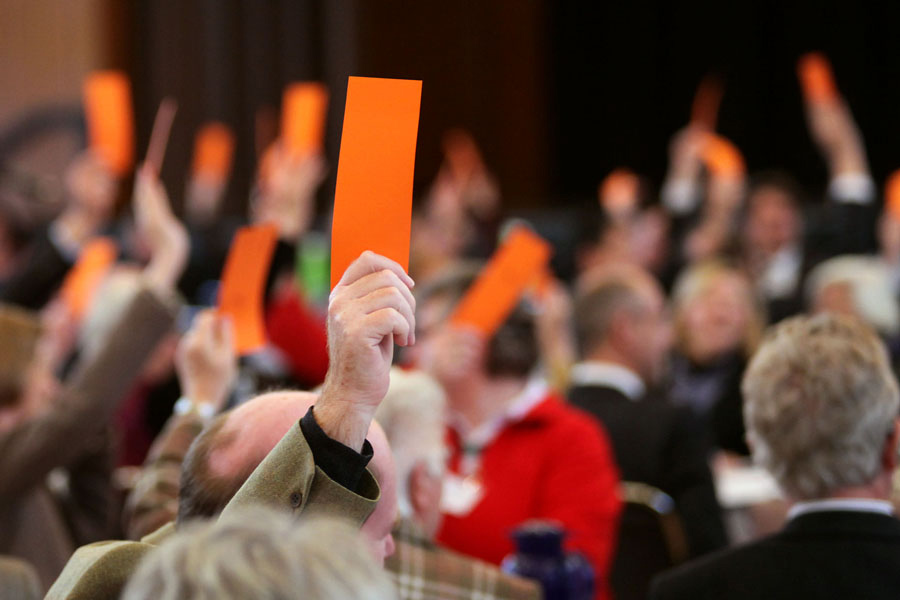
From May 1° to 5, some 120 thousand members of the German Evangelical Church met in Hamburg. 2500 events ranged from discussions on justice and a fair balance between money and happiness. "As much as you need" ("Soviel du brauchst") was the title of the 34th national conference, almost 500 years since the Reformation. Significantly, the sky and the city turned blue during the days of the meeting."May the Kirchtag continue living after the Kirchentag". The high number of participants, said Gerhard Robbers (Trier), coordinator of the Evangelical gathering, signals "a deep yearning for spirituality along with the need for a critical approach vis a vis the challenges of our times". One of the main guidelines emerged during the Kirchentag is "the request for fair salaries and equal working conditions. There should be equal job opportunities for all. The dialogue between Churches and trade unions must continue". The president of the Council of the German Evangelical Church (Ekd), Nikolaus Schneider, described the Kirchentag as a "source of strength and at the same time a creative place", for the transmission of "momentous religious and political thrust". Together for justice. For the first time in history the Kirchentag began on May 1st, Labour Day, thus political and social themes prevailed, while questions on the forthcoming national elections did not influence the works. German Chancellor Angela Merkel spoke on the theme of global justice: "Our wellbeing will be stable only when other countries will have wellbeing". In particular, the challenges linked to climate change and the ongoing financial crisis must be jointly addressed. A hot debate focused on peace and the armed forces, according to EKD news agency. Heavy attacks and condemnations were voiced against the minister of defense Thomas de Maizière (CDU) over the sale of arms to Saudi Arabia. The president of the Republic on inclusion. The president of the republic Joachim Gauck attended a round table in Hamburg on the theme: a "Strong society". In his speech, Gauck addressed the question of opportunities for the disabled and the theme of inclusion: "A person’s humanity can be measured according to how he deals with people with disabilities". Panel speakers included also Rev Rainer Schmidt, a protestant pastor without arms, and a young student, Samuel Koch, on a wheelchair after a serious accident occurred during a popular TV show. After having listened to the testimony of these two people president Gauck said: "If we use our inner strength we become stronger. This is true for all people", but he also regretted that conversely from the public sector, the educational realm in particular, in the private sector inclusion is yet to be fully implemented and needs to be strongly encouraged. Ecumenism and Pope Francis. According to the organizers, no Kirchentage to date has had such a strong ecumenical bearing as the meeting in Hamburg. 8,7% of participants who followed the meeting were Catholics. A small delegation of Orthodox Christians also attended the event, owing to the fact that the Kirchentag coincided with the Pasqal Tridium and the Orthodox Easter. Controversial theological questions are out of the picture while it’s significant that through dialogue and meetings the theme of ecumenism was integrated within the "general" program. The president of the bishops’ conference, Archbishop Robert Zollitsch, spoke at a round table on "The new pope Francis, interreligious and ecumenical expectations", along with the Secretary General of the Ecumenical Council of Churches Olav Fykse Tveit and the professor of Islamology Katajun Amirpur. In his very first speeches and meetings Pope Francis highlighted the common path to be followed by Christian faithful: "a path of hope, love and mutual trust", said Monsignor Zollitsch. "Pope Francis is in continuity with his predecessor. The Holy Father follows ancient and consolidated avenues to further develop them". Pope Francis "clearly expresses in gestures and words the Catholic Church’s irreversible commitment in the dialogue with Islam, Judaism and world religions, notably with Christian communities and Churches". Mons. Zollitsch urges "not to overburden the Pope with our Eurocentric expectations", at such a short time since his election. The next meeting for the 35th Kirchentag will take place in 2015. The president of the Central Committee of German Catholics Alois Glück invited participants to take part in the 99th Katholikentag titled "Building Bridges with Christ", scheduled to take place in 2014 in Regensburg, a city with a significant ecumenical tradition.
