GERMANY" "" "
A symposium on the Church’s presence in society

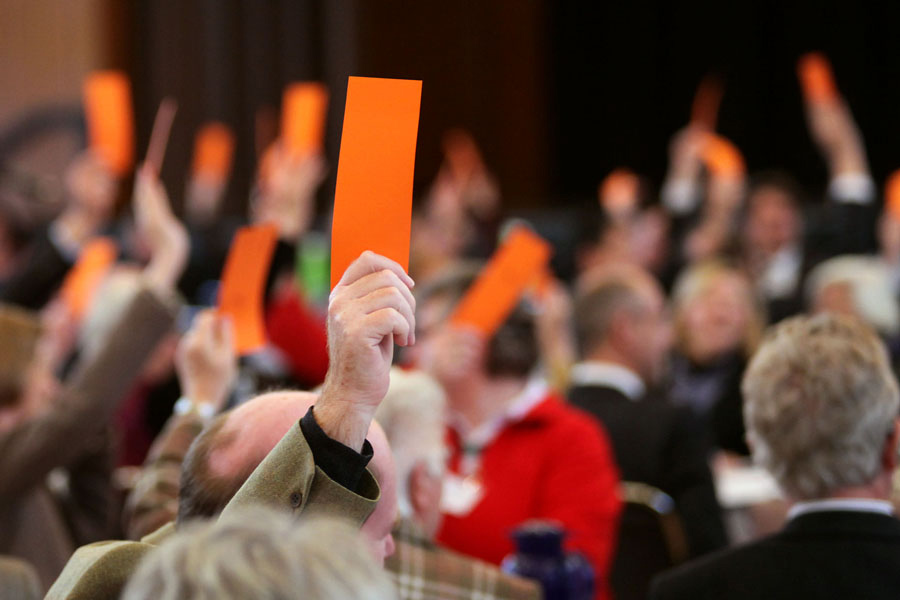
“The Church’s presence in society and in the State”: it is the title of the symposium jointly organized by the German Bishops’ Conference (DBK) and the Central Committee of German Catholics in Berlin (ZDK) April 18 to 19 at the Katholische Akademie. The theme of the conference was Church-State, relations with special attention to questions regarding the changes that took place in the public opinion on the meaning of religion and Church activity in modern society, at the level of social acceptance of various forms of cooperation between the State and the Church and the related repercussions in the political environment. On the agenda figured a debate on the ongoing situation, along with discussions on how bishops and lay Catholics should address the new emerging challenges. The joint DBK and ZDK Conference decided to consult on this theme also in the framework of the dialogue process of the Catholic Church currently under way. Follow the highlights emerged during the symposium. A Church for society. Monsignor Robert Zollitsch, DBK President, underlined that the question of the Church’s presence in society and in the State is a “fundamental theme” on which “lay people and bishops must reach a closer agreement. Germany is experiencing a tragic situation as relates to the acceptance of rules regulating Church-State relations”, he remarked. That’s why “it’s necessary to develop future prospects” since “at present the public opinion has a superficial understanding of religious freedom that seeks to limit individual religiosity to the private sphere. Conversely, we believe that religion is properly understood only if it is given public recognition, acknowledging its momentous contribution to society. That’s why it’s important to incessantly point out that it is not a question of ecclesial privileges”, added Msgr. Zolltisch. “The human person is at the centre of social activity, and therefore Church public commitment is not an end in itself but an important contribution to the common good”, he concluded. Reacting to changes. Alois Glück, ZDK president, called upon those present to address the issue with determination: “Those who withdraw to a defensive position loose the possibility of contributing to the debate as well as to political decisions”, he warned. “We ought to make the most of renewed sensitivity on questions of faith, to ensure that people might understand the role of the Church in society and at national level”. At the same time, he said, “it should be understood that the percentage of Christians is dropping significantly, also owing to demographic trends”. That’s why “we must actively react to the ongoing changes, in order to continue exerting cultural influence”. To do more for Europe. In his remarks on European integration and the Church’s presence in society and in the State, cardinal Reinhard Marx, archbishop of Munich and Freising, said that greater efforts are needed by the Church in Europe: “in her commitment to prevent the merits of Christians in Europe from becoming a historical reminiscence, the Church is called to contribute once more to a united Europe”, said cardinal Marx. The Church’s contribution should take place in her capacities as a partner in dialogue with institutions at all levels: “We have the possibility of communicating our requests and being heard. Many political leaders in the EU are open to the Church’s contribution. This favorable situation must not be wasted”, the cardinal warned, underlining that “as Christians we must contribute to the building of Europe, bishops and the laity alike”. At the end of the meeting, Monsignor Zollitsch and Monsignor Glück highlighted the importance of “jointly addressing the future of political Catholicism”, and to further extend Church action at European level.
