EU AND SOLIDARITY
Austerity is necessary but it’s not enough for the future of the EU

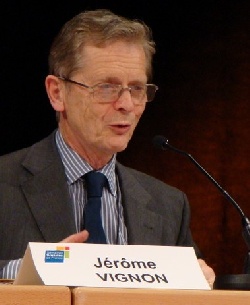
For Jérome Vignon, president of the national Observatory on poverty and social exclusion, president of the Social Weeks of France, widespread euroscepticism is possible when policymakers fails to prompt confidence and growth. Sarah Numico interviewed him for SIR Europe. IMF General Director Christine Lagarde, recently spoke of the need to find a balance between "recovery and support to growth". Which direction should be followed? "Mme Lagarde outlined that ECB’s accommodating monetary policy failed to prompt growth owing to the fact that the reform of Europe’s banking system is lagging behind. Monetary policies are adjourned because despite the measures adopted, credit to businesses remain too expensive while banks fail to apply to depositors the monetary benefits they receive owing to laxist monetary policies. In my opinion Mme Lagarde doesn’t want to encourage an even more laxist monetary policy but she describes the reform of the banking system a priority, notably bank reorganization in country in southern Europe, stepping up the adoption of a European banking system that would lift the burden of banking sectors bailouts in the most heavily indebted countries, mutualising the reorganization of the core capital of the banking system. If this doesn’t happen in the short run, the banking system will fail to absorb decreased interest rates which won’t be used for the reconstruction of core capital. Reorganization must be stepped up, and in doing so it’s important to avoid mutual competition between Member States. The banking union does exist as a single supervisory system, but it still lacks the powers to decide whether a failed bank should be reorganized or if it is lacking mutualised resources to cover its reorganization. For Mme Lagarde there is the need for more Europe, federalizing the European banking system under the aegis of the ECB. The proposal was made by Herman van Rompuy at the end of 2012, and it should take off in 2013". Recovery from the euro currency is invoked as a way out of the crisis, also in Cyprus… "It doesn’t surprise me, but it all boils down to demagogy. It won’t help Cypriots recover. The fact is that we haven’t been cautions when Cypriot economy had the possibility of entering the euro currency. It never should have happened as it’s a very artificial economy that thrives on money laundering. It’s hard to understand how it could have overcome the quality parameters of the public finance needed to enter Europe".There is strong opposition to the euro currency all across Europe! "It grew stronger because the victims of austerity measures have all reasons to think that the austerity is caused by the Troika (ECB, European Commission and IMF), thus by Europe. This reaction is understandable, even if we disagree. Austerity measures – critical to intra-European solidarity – aren’t Europe’s fault. Without solidarity the situation would be much worse, and the countries involved would obtain bailouts only at prohibitive costs. I wonder why euro area leaders have been unable to develop proposals to boost confidence in Europe. This is my criticism. I don’t think that austerity measures can be avoided, but why are there only austerity measures? First of all such measures should be applied with greater social justice (while the euro area fails to integrate the social justice criterion within the recommendations expressed in the framework of the European semester, which fail to take into account inequality caused by austerity measures). There is also a want of dynamism in the mid-term perspectives for euro area Europeans. For Germans employment is the consequence of cost reduction and production effectiveness. Thus their vision is focused on offer, but this vision must be coupled by an offer of future prospects, based on large-scale, public volunteerism. As Tommaso Padoa Schioppa once said, the EU must deal with growth, Member States must deal with discipline and the recovery of public accounts. It’s sad to see that EU budget has been cut in its driving aspects. This is the reason for Germans’ short-term perspective". What should we start with?"A substantial increase in own resources of the EU budget – I think it could be easily increased by 20-30% -, replacing national taxes with European taxes, so as to devote funding to projects for research, housing, education, and against poverty, to support the measures adopted at national level. Investing in the social sphere would boost employment and confidence, along with Europeans’ hopes. I also think that a larger EU budget could envisage support for modernization in Countries that are lagging behind, especially in the new member states, as in long-dated euro area countries"."