CHURCHES OF EUROPE
CCEE meeting for University pastoral care in Paris

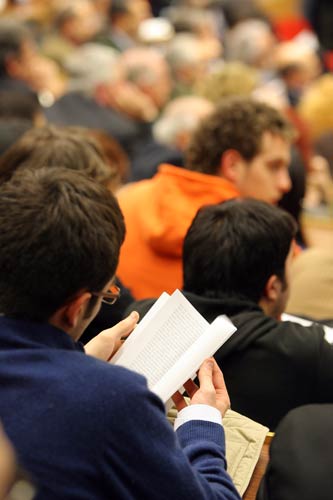
To help young university students and scientists recognize the essential bond between science and faith, between scientific findings and human life in its entirety, rooted in and reaching out toward God. It is the task as pastors and university chaplains according to Father Michel Remery, CCEE Vice-General Secretary, of the Council of European Bishops’ Conferences (CCEE), at the end of the meeting of the persons in charge of university pastoral care in Europe, held in Paris April 4-7. 40 participants, including bishops, chaplains and national delegates responsible for university pastoral work, and delegates from church associations and movements from 22 countries, discussed the issue of the relationship between science and faith with the help of experts and under the guidance of Msgr Marek Jedraszewski, President of the CCEE "Catechesis, School and University" Commission. Today the relationship between faith and science "is still perceived as an irreconcilable relationship", participants write in the final statement. Although "communication simplified by the media still tends today to present again the now outdated prejudice of a conflict between science and faith", among many young students religious questions arise".Challenges, risks and a new need for God. Retracing the history of human development, Fr A. Pinsent, Director of the Ian Ramsey Centre for Science and Religion of the University of Oxford, noted that the idea of a separation between science and faith is a stereotype, a preconception which does not respond to the reality: faith and science are absolutely reconcilable. This is testified simply by the great number of Christian scientists who down the centuries have contributed to the scientific exploration of reality. The expert underlined the existence of a an "aggressive atheism", which "blocks any form of dialogue". For Fr Pinsent "an indifferent or practical atheism is also problematic, reflected in the relative ignorance of both science and faith among many university students". For Professor Jacek Blazewicz from the Polish Academy of the Sciences in Poznan, the risk lies in the extremism of the positions, which propose a creationist vision of the world (faith ruling science) and those, which claim to be atheist or agnostic, where science rules over faith. Father Iosif Tiba, former university chaplain in Romania, said: "Despite the fact that young people seem to be more and more prisoners of the media and the Internet – which today constitutes the first port of call for the search for even existential questions and answers – nevertheless one notices a new need for God, a new perspective of God".Work in progress. The lectures delivered during the meeting highlighted the richness of activities and projects implemented by Bishops’ Conferences to tackle the challenges of university pastoral work, providing an original and essential contribution to the new evangelization project. The meeting with students from the Sciences Po (Politicial Sciences) centre was particularly enriching. Participants heard about the organisational model adopted by the French Bishops’ Conference from the person responsible for university pastoral work at a national level, Sr Nathalie Becquart consisting in Le réseau Ecclesia campus network between the different autonomous but inter-dependent bodies (associations, colleges, chaplaincies). The meeting ended on Sunday 7 April with a meeting with the international students present temporarily in Paris as part of the European Erasmus program.
