EDITORIAL
Words and cultures risk being impoverished

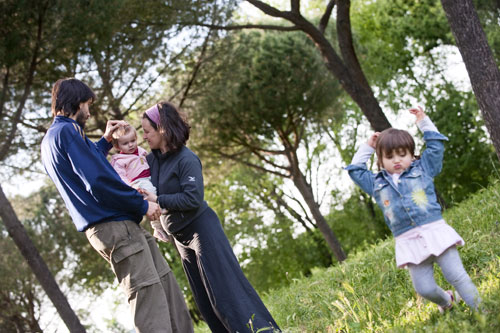
This year recurs the 30th anniversary of the Charter of the Rights of the Family, one of the great gifts of Pope John II. The document underlines, in particular, that the family is based on marriage, an intimate union of life in the complementariness between man and woman, which is open to the transmission of life. "The institutional value of marriage should be upheld by the public authorities; the situation of non-married couples must not be placed on the same level as marriage duly contracted", states article 1 of the Charter.Contemporary Europe has been overwhelmed by the wave of initiatives for the redefinition of marriage or for the legal recognition of the union between people who do not or cannot get married. In France, England and Poland the centre-right government coalition intends to endorse the legal recognition of same-gender couples, even though the Polish Constitution stipulates that marriage is the union between a man and a woman. I recently had the opportunity to speak with a French lawyer who strongly supports the proposal of "extending the definition of marriage", well-knowing that it would not be a minor amendment to a law, as it implies a deep change in civilization. This conversation helped me grasp the core of the issue currently debated across Europe. My interlocutor said that in the world there are no males and females, but only human beings, whose identity is vaguely linked with their bodies. These "angels" without a face nor a body have the right to freely choose their gender identity, resorting to a wide range of possible options. Accordingly, the foundation of these "identities" is not corporeity, but fluid mental states. Moreover, it’s hard to imagine such anthropology as the underlying foundation of any society. Indeed, what would be the stability of relations if someone "felt" him/herself man or woman without being able to guarantee the sustainability of that self-identification? Another theme of the conversation with the French lawyer was the definition of marriage. For my interlocutor marriage is an institution that regulates property, which is unrelated to procreation. The lawyer was surprised when he heard that marriage – from the social angle – is an institution for government of sexual activity, with the objective of guaranteeing the succession of generations. Thus defined the purpose of marriage is not subjected to cultural, historical or economic influence. Rather, it’s inscribed within human nature. The fact of being a link in the generation chain is under everyone’s eyes to see, even if one has no intention of bearing a child, as we remain the sons or daughters of our parents. However, my interlocutor maintained that procreation is unrelated to marriage in case of children born out of wedlock, not to mention the possibility of adoption or in vitro fertilization. I thus asked him if he agrees that a society based on such a philosophy treated children as merchandise that should be supplied to adults in compliance with free market rules. Third, I observed that often in the world war is waged by one side to impose its vision of reality on the other side. There is an attempt to de-construct Christian civilization with ideological motivations, starting with the idea of "tearing to pieces" primary social units such as marriage and the family. At this point we should admit that the phenomenon of the "deterioration" of words, stripped of their true meaning, is the cause and manifestation of a crisis in democracy. Take the term "marriage", that refers to the union of a man and a woman. If we try to use this term to describe different kinds of relations between people, we empty it of its explicit meaning, until the original meaning is erased and replaced with a different one.For example, in the 1950s in Communist Poland "progressive" socialists had organized a university conference for professors with a diverse cultural matrix. A young and enthusiastic speaker said that Marxism was the key that opened all doors. Kamizerz Ajdukiewicz, philosopher and logician, replied: "As far as I know, this object, the key, in Polish is called ‘picklock’." The attempt to manipulate language has been and remains an attempt to impoverish the intellectual life of a people. I hope that as relates to the family, people who are in contact with reality on a daily basis will say: "Enough! Please do not treat us like idiots!" From this perspective the Charter of the Rights of the Family can serve an important point of reference for all those who don’t want to loose themselves in the labyrinth of ideology. Also in Europe.
