CHURCHES IN BRIEF

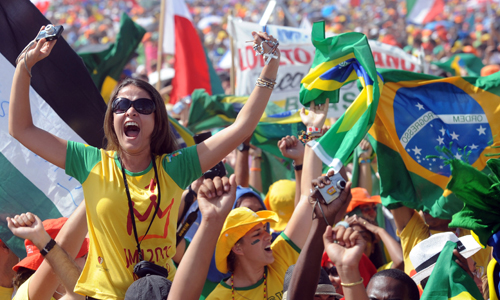
Portugal: an initiative for those who will not attend the WYD The youths that will not attend the World Youth Day in Rio de Janeiro next July have been invited by the diocese of Porto to share the event by joining the initiative "Rio sul Douro". The Diocesan Secretary for Pastoral Care of youths, Luis Leal, declared: "our goal is to bring to Porto the spirit of the world encounter through a link up with the young Portuguese people in Rio". The initiative, due to take place during the last two days of the WYD, will begin the morning of July 27 on the beach of Cabedelo, in Vila Nova de Gaia, near the delta of the Douro river, at the end of a walk from four different points of departure, retracing the path that normally precedes the vigil and closing Mass of the WYD". "Several workshops, followed by prayers and concerts" are tabled for the same day, while Sunday will be marked by the "catechesis of the bishop and the farewell Mass". During the meeting of the national department for the pastoral care of the youth held in Fatima, for the first time some of the 197 Portuguese volunteers registered in the WYD convened and shared the problems linked to the economic and financial crisis. "Many young people are striving to find the sums needed to cover the travel costs, however, given the current situation, we find it inappropriate to encourage them to cover such high costs" said Alberto Gonçalves, coordinator for Pastoral Care in the Archdiocese of Braga. Germany: interreligious meeting on secularism "The dialogue with those who are not members of the Church members or of a religious community is increasingly important for us". It is the conclusion the meeting held March 4 in Kassel between the German Bishops’ Conference (DBK), the Council of the German Evangelical Church (EKD), the General Conference (ARK) and the Orthodox Rabbis Conference (ORD) in Germany. The 7th annual meeting, announced in a release issued by DBK, is meant to promote in-depth reflections among participants, who this year addressed the theme of Catholics, Jews’ and Evangelicals’ approach towards rising secularism. The debate also broached the question of circumcision, object of a hot debate in the past months. Several speakers pointed out that a part of German society is distant from religious initiatives, displaying "worrying religious ignorance". Participants unanimously noted the divide separating religious and agnostic citizens. In order to bridge this divide it is necessary "to step up the dialogue on the meaning of Jewish and Christian traditions for European cultures, on religious freedom and on the right to the religious education of children. A pluralistic society from the religious and ideological angle requires everyone’s willingness and the ability to interact with people with different religious and ideological beliefs". For this reason, participants said, "also secularized public opinion should show respect towards religious life". Ireland: Bishops "concerned" about abortion law The Irish bishops speak up for the protection and promotion of unborn life following the Irish Government’s intention to legislate for abortion. In their plenary meeting in Maynooth (Dublin) on 6 March, the bishops reaffirmed in their final statement that they "remain deeply concerned about any intention to legislate for abortion in this country". The Irish Constitution prohibits the termination of pregnancy, but in 1992 a Supreme Court judgment authorised it when the life of the mother is threatened. The debate has reignited in recent months following the case of Savita Halappanavar, the woman who died of septicaemia at a hospital in October after doctors refused to perform a termination. Judicial authorities have launched an investigation into her case and the government was urged to hold a public debate to promote a new legislation. Hence the many declarations from the Catholic bishops aimed at showing "existing best practice in our hospitals" in Ireland with regard to maternal and foetal protection. Moreover, Ireland is among the countries with the lowest maternal mortality. Some politicians would like to introduce abortion "restricted" to certain cases when the mother threatens to commit suicide, as if "abortion – the bishops observed – were an answer to suicidal ideation, whereas current research indicates that suicidal ideation rarely relates to a single cause and that abortion itself can lead to suicidal ideation and mental health difficulties". The bishops also raised concerns about "the potential effect" of abortion legislation in Ireland "on medical workers – midwives, nurses, doctors and consultants – who wish to conscientiously object to being party to abortion in any circumstances". Finally, they observed: "international experience shows that legislative attempts to restrict abortion do not work. Once abortion becomes permissible in a country, any limits to its availability become eroded over time". "Abortion is the direct and intentional destruction of an unborn baby and is gravely immoral in all circumstances", the bishops wrote, insisting on the importance of upholding "the equal and inalienable right to life of a mother and her unborn child in our laws and medical practice".
