
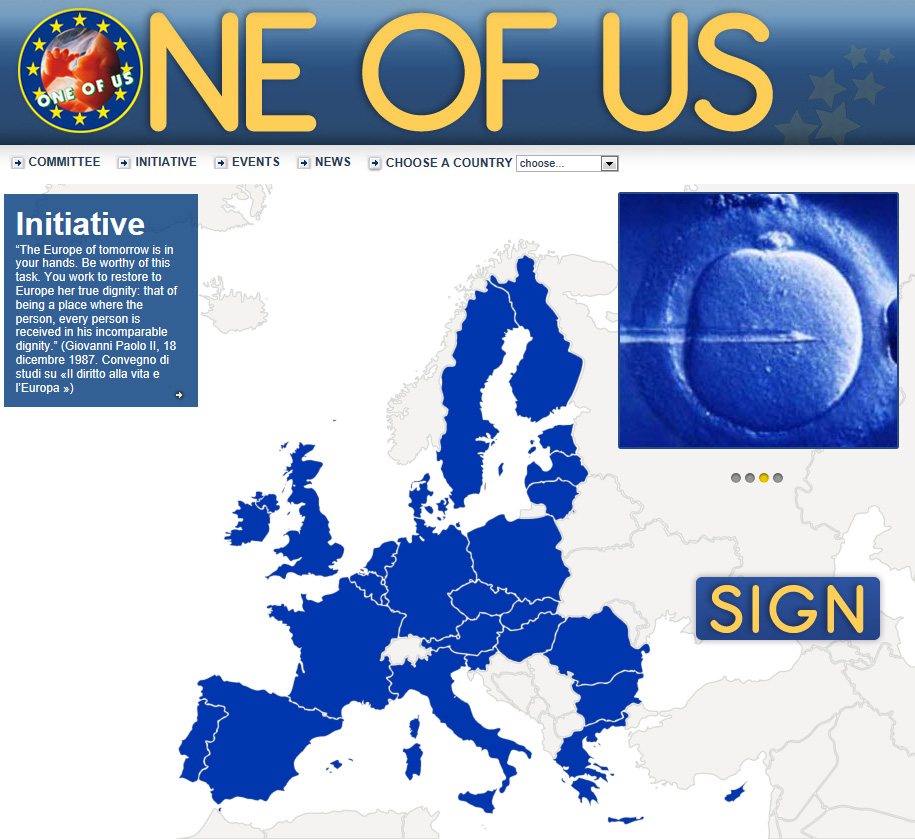
"European initiatives" 15 so far, including "One of us"To date, 15 citizens initiatives are still open to signatories who wish to submit an invitation to the European Commission to propose legislation on matters where the EU has competence to legislate. For further information and endorsement log on http://ec.europa.eu/citizens-initiative. The most renowned initiative is "One of us", promoted by pro-life organizations calling for the respect of human life in EU activity, notably in the areas of research and international cooperation. The protection of the embryo and the fight on abortion should be key aspects of community policy, according to the promoters, starting with EU funding and partnerships with international organizations. At least one million signatures must be collected by November 1st 2013. Many associations are already actively engaged across some twenty countries for the collection of signatures and to raise cultural and moral awareness. Other recent initiatives accepted for presentation to the Commission regards a single communication tariff; another proposes to limit to 30 km/hr the speed of vehicles in urban areas. The initiative on media pluralism calls for "Protecting media pluralism through partial harmonisation of national rules on media ownership and transparency, conflicts of interest with political office and independence of media supervisory bodies". Two billion to investigate the brain and graphene On January 28 Neelie Kroes, vice-President of the EU Commission, presented special funding for two major research projects, already under way, which involve almost 200 scientific centres in Europe. The "Graphene" and "Human Brain" initiatives are set to receive one billion euros each, "to deliver 10 years of world-beating science at the crossroads of science and technology". In particular, the Graphene project (led by Prof. Jari Kinaret, from Sweden’s Chalmers University and involving over 100 research groups) will investigate and exploit "the unique properties of a revolutionary carbon-based material". It is "an extraordinary combination of physical and chemical properties" – the Commission explains -: it is the thinnest material, it conducts electricity much better than copper, it is 100-300 times stronger than steel and it has unique optical properties". The "Human Brain Project" (led by Prof. Henry Markram of the École Polytechnique Fédérale de Lausanne; involving scientists from 87 institutions) aims to create "the world’s largest experimental facility for developing the most detailed model of the brain for studying how the human brain works and ultimately to develop personalised treatment of neurological and related diseases". The research "lays the scientific and technical foundations for medical progress that has the potential to will dramatically improve the quality of life for millions of Europeans". Commissioner Kroes added: "To keep Europe competitive, to keep Europe as the home of scientific excellence, EU governments must agree an ambitious budget for the Horizon 2020 programme in the coming weeks", that clearly refers to the European Council of February 7-8 where the heads of Government and State are called to take decisions on the EU’s multiannual budget 2014-2020. ERC grants to top researchers "The European Research Council is selecting top researchers. ERC funding is leading to an increasing number of scientific discoveries, as well as more publications in recognised scientific journals". Máire Geoghegan-Quinn, EU Commissioner for Research, explained the meaning of the new funding for scientific projects and innovation drawn up last week. ERC is awarding 680 million to 302 senior "research leaders" and experts advanced grants) in 24 States. "The projects selected cover a wide range of topics", the Commissioner explained. For example, "a scientist and his team in France will develop new models to explain certain physical phenomena like superconductivity; a team based in Latvia will bring together computer science, physics and mathematics to assess the advantages and limits of quantum devices". Researchers were selected out of some 2,300 applications submitted to the ERC. "Advanced grants are awarded to well-established top researchers of any nationality or age, who are scientifically independent and with a recent research track-record and a profile which identifies them as leaders in their respective field(s)", the Commissioner pointed out.
