EUROPEAN HISTORY " "
Burgomaster from Berlin, a Socialist loyal to Western societies, held in high esteem by Paul VI

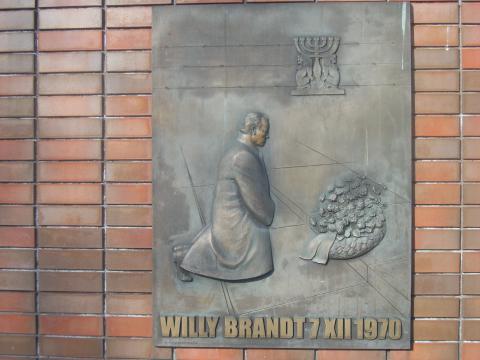
“Willy Brandt is still with us”: is the title of a dossier with which the leading German cultural magazine “Die Zeit” celebrated the hundredth anniversary of the birth of the political leader (December 18 1913) which remains a legend, not only for Germany.In Warsaw a monument in memory of Brandt was erected in the same square in which stands the memorial of the Jewish victims of the Ghetto, before which the then head of the German government fell on his knees during an official visit to Poland. Those were minutes of moving silence, forever captured in a memorable photograph. European democracy owes a lot to the “chancellor of the hearts”, as described by another German weekly, “Der Spiegel”, usually unlikely to use tender words with powerful figures, whether living or deceased.We have seen Brandt at work especially during two major occasions. First, during the congress of the Social Democratic Party in 1959 in Bad Godesberg, when SPD ratified its choice of freedom. At the time Brandt had been serving as mayor of West Berlin for over two years and was a leading member of the movement that initiated the so-called Bad Godesberg program, which changed the Party’s neutrality vis a vis its “allied” East European Communist dictatorships.His determination was conveyed in a statement to the Congress. In fact, he had all the qualifications for not being accused of reactionary of revanchist sympathies. Of humble origins, he had been a member of the Socialist youth – the radical wing of the Party – during the Weimar Republic. Wanted by the Nazi police when Hitler came to power in 1933, he escaped to Norway where he represented the opposition in exile and assumed Norwegian citizenship after the regime had stripped him of his German one. A reporter for the Party newspaper, he corresponded from France and Spain during the Civil War. He was forced to flee again to Sweden upon the Wehrmacht’s invasion of Norway. After the end of the war he followed the Nuremberg trial for the press and settled down in Berlin. In 1948 he was returned his German citizenship and went back to militate in the SPD in which, as mentioned, his commitment was determinedly pro-western. In his speech delivered as doyen of the Parliament of reunified Germany, on December 20, 1990, he recalled: “We could not have preserved our freedom without the protection of the Atlantic alliance and without the solidarity of the European community”.The second tragic circumstance recorded in history is when as of August 13 1961 Communist Germany – supported by the Red Army – confined over two million people behind a wall erected in the city of Berlin. On the following day Brandt spoke from the balcony of the Schoeneberg city hall to an exasperated crowd, raging at the East-German police and the Russian tanks. In a passionate speech, which was also a tribute to freedom, he managed to prevent what would have otherwise been a massacre and unpredictable consequences. He obtained all possible assurances for his cities by Western powers, by Bonn’s Germany and even by the Soviet Union. Berlin’s population, who unanimously supported him, never forgot their burgomaster.In the 1960s Brandt assumed increasingly important roles, from the SPD presidency to his candidacy as Chancellor. In 1969 he managed to bring the Liberals away from an alliance with the CDU and formed a government that led him to two victorious elections until 1974, when he resigned after the arrest of one of his assistants, Guenther Guillaume, “infiltrated” from Western Germany.Bonn’s politics of openness to the East was designed in that short timeframe, with the realistic recognition, inter alia, of the Democratic Republic, along with a set of measures which built up to the fall of the Berlin Wall in 1989. Brandt’s untarnished curriculum also favoured relations with official Poland, whilst occasioning concrete support to the Solidarnosc movement through Germany’s trade unions.He entertained good relations with the Churches, and close ties, that could be best described as friendships, with Catholic and Protestant dignitaries. In 1970, in his capacities as Federal Chancellor, Brandt was received in private audience by Pope Paul VI, who welcomed his political actions and lauded the recovery of German civil society. The two interlocutors shared a common view of Europe, a key aspect of Bonn’s politics led by Brandt and a certainty of peace and a hope for the rest of world with a view to future developments (due to take place) for Pope Montini.The above-mentioned issue of “Die Zeit” features the personal testimonies of Brandt’s contemporaries and posterity on a political leader who honoured democracy, peace, and his Country. The unforgettable title is: “The other German”.
