LITHUANIA" "
Six bishops from the Baltic country have visited COMECE and EU institutions

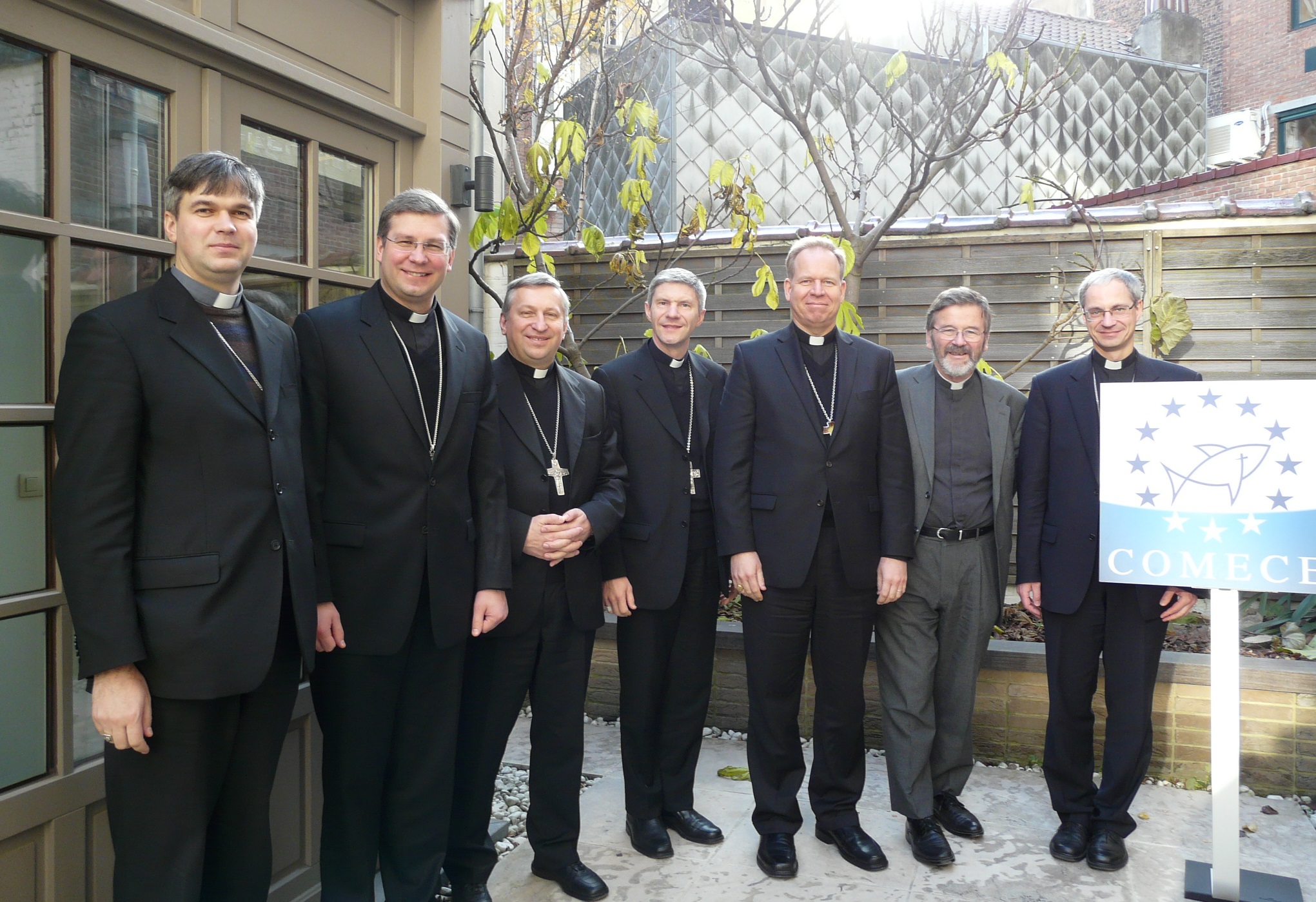
“In view of the upcoming European elections in May 2014, we wish to express our gratitude for all that has been accomplished over the last 60 years by the integration project. We welcome a European project based on the principles of the dignity of the human person, the shared promotion of the common good, global solidarity, the development of peoples and the promotion of peace as formulated in the encyclical ‘Pacem in Terris’, published 50 years ago by Pope John XXIII. Rediscovering these principles would provide a solid foundation for a stronger Europe”. It is the message from Brussels by the bishops of Lithuania, on a visit from 1 to 4 December to COMECE (Commission of the Bishops’ Conferences of the European Community), where they were welcomed by the Secretary General Msgr. Patrick Daly, and by the EU institutions. Society, politics, religious faiths. The permanence in Brussels of the Lithuanian bishops – the Archbishop of Vilnius Gintaras Grusas, and Msgr. Rimantas Norvila, Msgr. Lionginas Virbalas, Msgr. Linas Vodopo Jánovas, Msgr. Kêstutis Kèvalas and Msgr. Arunas Poniskaitis – turned out to be an occasion to discuss at length the rich presence of the Catholic Church in Europe, the dialogue between faiths and the EU, the role of common institutions at the service of the peoples of the Old Continent, within a particularly problematic economic and geo-political framework. The bishops have met, inter alia, with representatives of the European Parliament, the Commission and the European Council. With SIR Europe, they drew a balance on the 10 years of Lithuania’s presence in the European Union. The rotating presidency of the EU Council of Ministers will be held until December 31 by the government of Vilnius. “Global solidarity, coupled by the principle of subsidiarity, is the cornerstone of a community of nations living in peace and prosperity at the service of its peoples”, they said in unison. “A Christian concept of the family is, in our opinion, consubstantial with this view. That’s why we launched a Year of the Family in Lithuania”. The force of history. The six bishops in the Belgian capital – of ten active in the country, in addition to bishops emeritus – highlighted a set of themes that involve the Catholic community, other faiths, and civil society in Lithuania, which are placed “at the crossroads between the east and the west of the continent”. Emphasis was placed on the historical past, (especially in relation to the Soviet Union and the communist past), on the coexistence of the communities of believers, accompanied by worried reflections on neighbourhood issues (with special regard to the case of Ukraine, where demonstrations are ongoing). “In the present decade our country has experienced the benefits of being part of the European Union and Brussels has granted funding that has helped our economy to emerge” after the fall of communism, said Msgr. Gintaras Grusas. “The population, however, is concerned about the moral perspectives” and for the phenomenon of secularization, present “throughout the continent”, he told SIR Europe. “I believe that even the rest of Eastern European countries are contributing to the debate on these issues, bringing their unique experience” in the context of continental Europe. In Brussels, Msgr. Grusas delivered a comprehensive talk on security and the integration process at the Chapel for Europe, as part of a series of events promoted by COMECE in view of the European Parliament elections. The bishop addressed a range of issues related to security, including – in addition to the traditional aspects of defense, armaments, the fight against terrorism – also themes regarding the economy, energy, human rights, the development of political relations with the neighbouring countries, migration. All eyes on the Union. Has Lithuanian citizens’ degree of interest towards the EU grown in the past ten years since adhesion? “It has indeed – said Msgr. Rimantas Norvila, representative of the Lithuanian bishops at COMECE – especially in recent months, coinciding with the Presidency of the EU Council of Ministers entrusted to our government. But even the media have done their share, and the same can be said for migration, since our migrants maintain close relations” with their country of origin, and many of them return to their homeland”. Regarding the situation in Ukraine and the EU Eastern Partnership, Msgr. Lionginas Virbalas said: “I believe that the majority of citizens look favourably at the country’s rapprochement with the EU Also because they witness the widespread economic and social crisis in Ukraine.
