EU ELECTIONS " "
Interview with Martin Schulz, president of the Parliament in Strasbourg

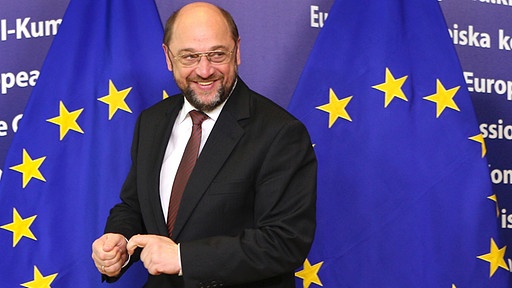
The upcoming European elections “should provide an opportunity for discussion on concrete European players, rather than being reduced to a yes or no to the EU. Transforming the elections of May 2014 in a battle between Europeanists and anti-Europeanists would mean making a favour to the populists and to those who don’t believe in the great European project”. Martin Schulz, 58, married, two children, cultivates a passion for history, literature and soccer. Social-Democratic mayor of Würselen for 11 years, he was elected at the Euro-chamber in 1994. On January 2012 he was elected president of the European Parliament. In these capacities he met Pope Francis past October 11 at the Vatican. In view of the renewal of the Assembly in Strasbourg Gianni Borsa drew a balance of the situation with president Schulz, with a glance to the future of continental integration. President, let us start with the role of the European parliament. The Treaty of Lisbon that grants greater powers to the Assembly came into force in 2009. In your opinion has the role of the EP gained major thrust in the political architecture of the EU? “Over the past four years we have witnessed three significant developments in the functioning of the European institutions: a strengthening of the European Council of Heads of Government and State, a weakening of the Commission, and the strengthening of Parliament. The growth of a managing role of the economic crisis on the part of the Council is understandable and disturbing at the same time: understandable because the heads of state have long been the only ones with the legal and financial resources to cope with the crisis; worrying because the decisions taken unanimously and behind closed doors proved to be often late and ineffective. Moreover, the Commission has in part been the victim of the institutional growth of the EU Council”. And the European Parliament? “The European Parliament has been the true defender of the ‘community method’, which envisages cooperation between institutions in favour of the general interest of the EU. The entry into force of the Lisbon Treaty and the extension of the co-decision to include several legislative areas explains only a part of this phenomenon. The reasons are to be sought primarily at political level. Consider some of the most important reports of the present term – from the Multiannual Financial Framework to financial supervision, from economic governance to the protection of personal data – which show that Parliament has never refrained from proposing truly ambitious, European measures to the Council. Not always our position has prevailed, but our negotiation has had an undeniable added value”. You have often pointed out that the Parliament elected with universal suffrage represents European citizens. Do you believe that MEPs truly represent the sentiments of the public at large? Do they defend citizens’ interests? “I’m sure they do. Since 1979 the European Parliament has never ceased acting as the bearers of citizens’ voices. MEPs are in most cases the bond linking citizens and institutions in the EU. With due exceptions my colleagues do a wonderful job and are good representatives of popular sentiment”. Possibly also owing to a responsibility of the mass media, for a long time the EU has been associated with the economic crisis. Yet in Brussels and Strasbourg the leitmotif is: Europe is part of the solution, and not the cause of the problem. What does this mean?”The EU has not been the cause of the economic crisis and has partially stemmed consequences that could have been much more serious. But tensions between Member States have increased enormously, excessive austerity was imposed upon weaker States, while the Union has failed to create an anti-cyclical policy to boost the economy, which, however, the United States managed to do. But to speak of Europe’s fault tout court is a mistake”. Migrations is another continental urgency. Does the principle of solidarity, aimed at a joint management of the migration phenomenon, have a chance? “Also in this framework the European Parliament has been the bearer of an unpopular message to member States by asking that the tragic events on the island of Lampedusa trigger a turning point for Europe, and asked the EU and its member States to ensure that migrants enjoy fundamental universal rights, unaccompanied minors in particular”. Populisms and nationalism are on the rise. To what extent will they affect the outcome of the May 2014 elections? What could be done to prevent a legion of anti-Europeanists from holding seats in the European Parliament? “There is an evident risk. Populists and nationalists are likely to obtain a large number of seats at the next European Parliament. But I did not give up, nor am I intimidated. Indeed, the emergence of these movements prompts to increase efforts to spread information on the benefits of our common project and on ideas to improve it. Populist and nationalist parties are very adaptable, but their ideas are not feasible, theirs are backward-looking ideas. My role will be to expose the triviality of their message and propose a credible alternative. But my greatest enemy in the upcoming elections will be indifference, namely, to think that participation and politics are no longer important. In a rapidly changing world, change is always possible for the good or for the bad. It is a warning and a message of hope so as to be the protagonists – and not the spectators- of change”.
