EDITORIAL" "
Referendum on December 1° for the definition of marriage in the Constitution

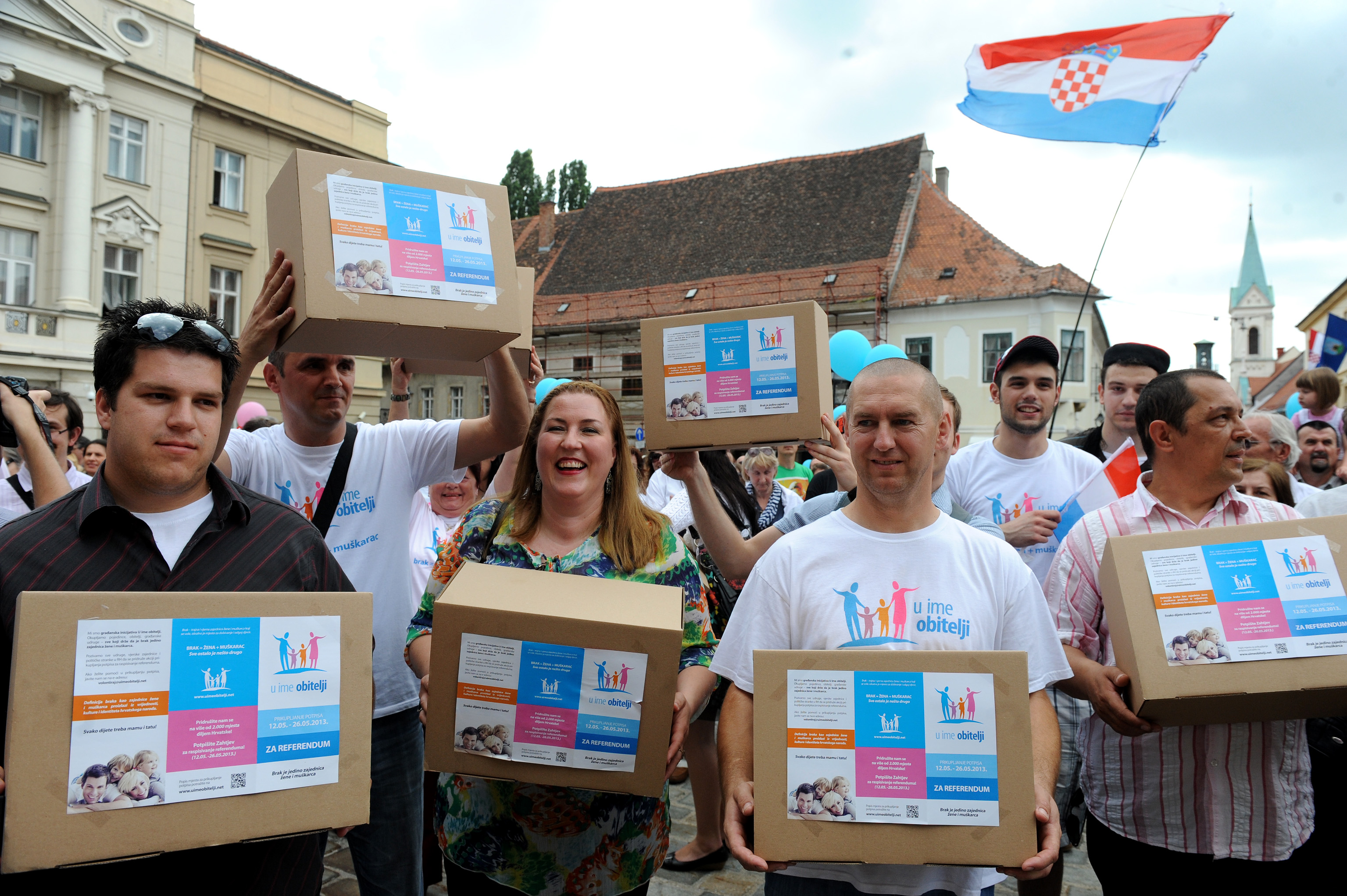
In Croatia will be held on December 1 a referendum on the introduction into the Constitution of the definition of marriage as a union between a man and a woman. The referendum is in itself a great success of the citizens’ initiative called “In the name of the family”, which has managed in 15 days – the timeframe envisaged in referendum legislation- to collect 750 thousand signatures. In Croatia, that has approximately 4.5 million citizens, this means the support of about 20% of those entitled to vote. The signature collection took place in adverse circumstances, because on the one hand, the government organized a campaign against the referendum and, on the other, organizers and volunteers were exposed to humiliation and physical attacks. However, the required number of signatures in support of the referendum is not entirely clear, since a month before EU accession Croatia experienced a demographic increase, and the Minister of Administration changed the official number of voters from 3 million and 760thousand in previous consultations, to the current 4 million and 560 thousand. Now, the problem is to ensure a sufficient number of seats, so that access to the popular vote is not impeded. It will now be necessary to mobilize voters and obtain a majority of votes in favor of this constitutional amendment.Among the EU member states the definition of marriage as the union of a man and a woman is enshrined in the Constitution of Lithuania (Article 38, 1992), Poland (Article 18, 1997) and Hungary (Art. L, 2011). When, in the Nineties, such definitions were introduced for the first time in national Constitutions it seemed like a totally useless clarification: marriage as a union between a man and a woman was at the time taken for granted. No person had doubts about this acknowledgment and the related guarantees were provided for, for example, in Article 12 of the European Convention on Human Rights (ECHR).A significant change in European law was introduced with the European Charter of Fundamental Rights of man, whose art. 9 “modernized” article 12 of the Convention by removing the definition of marriage altogether. An issue that needs to be tackled is the “creative” approach of the European Court of Human Rights, which in its case-law is trying to reinterpret the definition of marriage. This illustrates one of the paradoxes of European integration. While in many areas of European law integration is provided for, the central question of marriage and the family in Europe brings about major disintegration.Croatia’s Initiative therefore reminds us that in the European continent there are two counter-trends. The anti-family trend is evident in the recent change in the law in France and the United Kingdom and in the legislative initiatives in Ireland and Malta, so far traditional bastions of Catholicism. The other trends observed, especially in Central Europe, aim at increasing protection of the institution of marriage and the family. The Croatian referendum shows that even in that part of Europe, in public discourse, there are different positions, but the tendency to de-construct marriage and the family met with strong opposition from a significant part of the population. It should be noted that these societies of Eastern Europe have experienced communism, which had among its aims the destruction of the institution of marriage and the family that was the last bulwark of the defense of humanity against Sovietization.If Croatians manage to introduce, thanks to the referendum, the constitutional definition of marriage, they will contribute to protecting the national legal system from the pressure of the various international ideological groups that act against the family and they will say to other countries, including Ireland, that the direction of social and political processes is determined by the people and not only by the powers.Croatians will thus confirm that the European crisis in marriage and the family is temporary and that hopefully our societies will soon recover their natural balance.
