COMECE" "
Plenary Assembly dedicated to current events, migration and trafficking

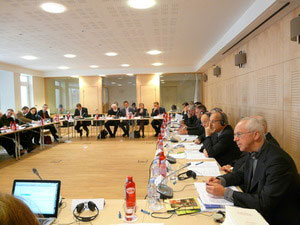
A matter that is “of great concern” to the Church in view of the upcoming election of the EU Parliament in May 2014 is “a mounting anti-EU mood in various member states”, conveyed by “political parties with a nationalist (and often xenophobic) agenda moving from the margins into the main stream”. For this reason the ecclesial community is called “to reminding people of the foundational (Christian) values of the EU project and of European society. Card. Reinhard Marx, president of the Commission of the Bishops’ Conferences of the European Community (COMECE), highlighted this theme during his introductory speech at the plenary meeting held in Brussels November 13-15. Message for the elections. “We need more Europe to secure a better Europe”, said Cardinal Marx, opening the works of the autumn assembly of the ecclesial body. The plenary focused on the theme of migrations, whose opening ceremony was held in the Chapel for Europe, in the EU institutions’ district. The speech by Card. Marx was articulated in several chapters, starting with the election of Pope Francis and the meeting with the Pontiff by the COMECE presidium past May. Another chapter focused on “the voice of the Church in Europe today”. To this regard His Eminence announced a document that will be presented in 2014 in view of the elections for the European Parliament. Special mention went to the citizens’ initiative One of Us, with the collection of one million 800 thousand signatures pro-life across the EU. How to exit the crisis? The COMECE president delved into other “crucial issues” the bishops are called to address in the present circumstances, notably migration, the economic crisis and its repercussions, surging populisms and nationalisms, legislative processes under way in several EU countries and within Community seats on issues of ethical nature. Regarding economic themes, Cardinal Marx said, inter alia: “There is a growing conviction within the EU that the traditional solutions are not working in the present crisis”. The fact is that “neither statesmen, politicians nor civil servants really know how to move out of the crisis. There is a lack of “creative” and appropriate solutions “which take account of the ethical principles which need to be at the basis of a free, open, democratic, prosperous society which is open and just”. Marx thus prompted reflection on whether “this is an area for a contribution from the Church”. At home, amongst us. As relates to migration, in their final statement the COMECE bishops emphasized that should peaceful circumstances or social and economic conditions in their countries of origin permit it, “most who at present opt to migrate would prefer to stay and make lives for themselves and their families at home”. Thus “greater outside assistance” to “countries of origin and support to countries of transit is needed to stem a migratory flux”. The European bishops equally called for a more coherent EU migration policy” coordinated with other policies of the Union – such as Trade, Cooperation aid and Foreign affairs. COMECE Bishops are “worried about xenophobia directed against migrants in some parts of Europe”. They pointed out that migrants “are an opportunity for our societies and parishes in terms of talents, cultures and skills they contribute”. It is therefore “essential” that parish communities throughout Europe welcome migrants and “do all they can to make them feel at home”. The problem of trafficking. Another topic addressed in the three day plenary in Brussels was human trafficking, which is closely linked to migration. It is estimated – the bishops said – that in Europe 880thousand people are victims of trafficking, exploited for forced labor, for the ‘”sex industry”, for organ trafficking. During the meeting, resounded the testimony of a woman victim of trafficking, now member of the Sophie Hayes foundation. A British expert also intervened who presented an experience of successful cooperation between Scotland Yard and the Bishops’ Conference of England and Wales, in the field of counter-trafficking and rehabilitation of victims.
