RELIGIONS IN THE MEDITERRANEAN
Msgr. Soueif (Cyprus) reflects on the role of religions in the Middle East

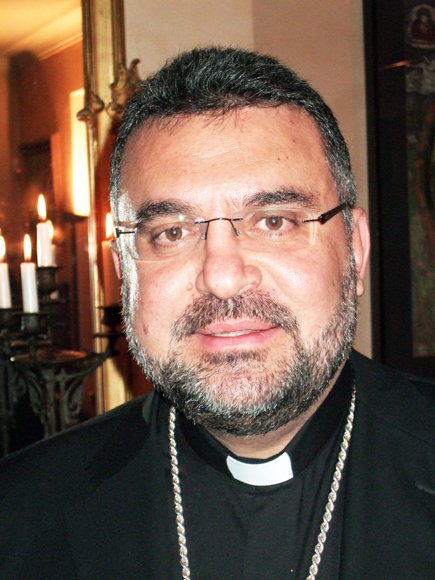
“We all need to purify our minds and hearts to build peace, that very peace which God gives to humanity”: the Maronite Archbishop Youssef Soueif from the Eparchy of Cyprus, pointed out. The Archbishop indicates a specific task for religions: “Being the bridges of peoples and cultures and the building blocks of the common good”. Strong, determined, and yet mild words, pronounced by a man of faith living in the delicate situation of Cyprus, an island with an Orthodox majority, but split in two by the “green line” that since 1974 separates the Greek Cypriot area from the area occupied by the Turks. “We Catholics are a small minority here”, Msgr. Soueif, who served as Secretary of the Special Synod for the Middle East ended in 2010, told Sir Europe, “and as such we would like it to be a consistent sign of reconciliation”.You argue that religions are an “instrument of peace”. Is this always true? Have there not been in the past, and maybe sometimes still today, opposing radicalisms?”It is misinterpretation of faith that leads to divisions, radicalism, prevarication. Religions encompass within their own patrimony the way of peace for the good of humanity. It is also true that the same religious communities live in given temporal circumstances, within precise historical-concrete circumstances, which have deflected their underlying message. Faiths didn’t always live out their purity and integrity for they have been conveyed by the women and men who embodied these circumstances: they were thus incorporated within human history – within its interests, politics … Thus dark pages have been created. Religions must always recover their essential mission, the message of love and universal brotherhood. This is true both for Christians and for Jews and Muslims. And for us Christians, the central point is Jesus, donated to us and who donated Himself for love”.But, as we noted here in Cyprus, Christians in turn experience divisions. It is not a sign of contradiction?”Indeed it is. The human person must be purified to be worthy of God’s message. This is also an internal challenge for Christianity, and therefore the ecumenical journey is more important and urgent than ever. The unity of Christians can become a clear sign for other religions and for all of humanity”.The Catholics of the Maronite Church of Cyprus are a few thousand in a country with nearly one million inhabitants. How is it living in this situation?”We are fully aware that we are a minority, but society is not only measured in its ‘quantitative’ aspects. Minorities – and in Cyprus there are many – can play a creative role, with initiatives that demonstrate that we are an integral part of the country and at the same time that we work to create bonds for the good of all. We would like to bear witness to our faith, preserving our identity. Moreover, the world today is made up of ethnic, cultural, linguistic, and religious minorities who meet each other. It is therefore necessary to make a joint effort to promote unity and the common good. I think this is one of the tasks which Christians in the Middle East are called to fulfil”.The Greek Cypriot part of the island belongs to the European Union, the other part, with a strong Turkish presence, does not. Not only: there are evident signs of division between the two communities. And in the Turkish majority area, the signs of Christian presence from churches to cemeteries – have been removed or destroyed. How do you view the situation? What could be your role?”The situation is difficult. Since 1974, the political separation policy has also become demographic, cultural and religious, with social consequences on the population. As Maronite Church we would like to serve as a ‘bridge’. With our presence, we wish to bring signs of hope and dialogue, showing young people that respect and mutual understanding are possible. We are moving in this direction for a future based on justice and peace. Our small communities are, in my view, a sort of ongoing pilgrimage toward God and towards others”.You took an active part in the Synod on the Middle East. What remains of it today, three years since its conclusion?”I think that the most significant legacy of the Synod was the confirmation of the choice of peace and freedom. The latter declined in all its manifestations, including freedom of religion and conscience. Now we need a broader process of sedimentation of this legacy. And Christians – supported by a renewed spirituality – are called to convey it in everyday life, addressing with the same constructive spirit the themes of justice, labor, education, social development, environmental protection. Only then can we be seeds of peace”.
