CHURCHES IN BRIEF " "

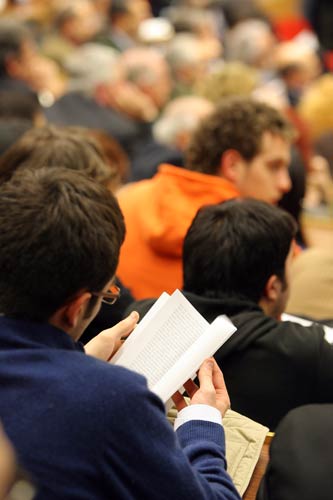
Spain, catholic university students at the Pilar A few days ago two hundred university students from all over Spain undertook their first university pilgrimage to the Pilar, the so-called “Pilarada”, in Zaragoza. They walked for 18 km, the distance separating Sand Jorge University (Usj) from the cathedral-basilica of Pilar, where a Eucharistic celebration and a simple bouquet of red carnations closed the day. The pilgrims – students and professors – entrusted the new academic year and Gospel proclamation to the Holy blessings of the Virgin of Pilar. The pilgrimage, promoted by the National Association of Catholic Propagandists (ACNdeP, founded in 1909), a lay association whose mission is to spread Catholic faith, left from the USJ campus in Villanueva de Gállego, with a catechesis by the bishop of Teruel-Albarracín, Monsignor Carlos Escribano who encouraged young people of “live the joy of faith”. The Pilarada was promoted in the final part of the Year of the Faith. The pilgrims, the organizers said, “were enthusiastic about the initiative and said they want to repeat it next year with friends”. The Association of Catholic Propagandists could rely on cooperation with the San Jorge University and on that with the Atheneum Ceu San Pablo. The initiative will become “an annual event that will bring together the academic community in Spain to entrust the year to the Holy Virgin”. Portugal: “Rebuilding community life In an address delivered on the occasion of the Fourth Day of Practical Theology, promoted by the Institute for Religious Sciences of the Catholic University, the patriarch of Lisbon said: “the main pastoral problem which the Catholic Church is called to address today is rebuilding the Church life of the community”. In the framework of the theme of the meeting, “When I feel weak I am strong, for a theology of vulnerability”, monsignor Manuel Clemente held a conference titled “Are we sailing without a map? Christian witness in an uncertain world”. Msgr. Clemente thus remarked that “current events don’t allow us to make forecasts for the future, it must be built day by day”. “If there’s a time when this map is not clear and is created day after day that is the present time. We make adjustments as we move on and we design our map during the journey”. For Msgr. Clemente, “we are navigating in a sea of unpredictability, ranging from the needs of the population to ecology, both because we know the reality of the world only from a very limited space such as Europe, and because the sustainability of the planet will force us to make major structural changes”. In this context, the Church is “faced with a specific challenge ” and “she must avoid losing identity in the framework of the dominant culture”. The Church in the Czech Republic, online goods and services What will the local impact of the State-Church agreement signed in the Czech Republic? What is the value of the goods that will be returned to the Catholic Church? What is the amount financial compensation? The answers to these and other frequently asked questions is available online on the new website launched by the Czech Bishops’ (www.sluzbaverejnosti.cz) that deals with questions on the property agreement envisaged by the Act of November 2012. On the website are presented the public services offered by the Church in the Country, notably “spiritual services, assistance to the elderly, sick people and the needy, support to families, education, defence and enhancement of the cultural patrimony and strengthening of local community activities”. According to the promoters of the initiative, “the agreement will help maintain and improve the quality of these services that benefit the whole of society”. Poland: a centre for Ukrainian Greek-Catholics A new pastoral center for Ukrainian Greek Catholics was opened on 27 October in the city of Piaseczno near Warsaw, Poland. Rev. Myroslav Turkota, priest of the Mukachevo Eparchy of the Ukrainian Greek Catholic Church (UGCC) in Transcarpatia, was appointed the pastor of the newly-created institution. According to the website of UGCC, opening of the new center in Poland became possible thanks to the agreement between archbishop Ivan Martyniak, UGCC Peremyshel-Warsaw metropolitan and cardinal Kazimierz Nycz, Roman Catholic metropolitan of Warsaw. Representatives of UGCC hope this institution will contribute to development of pastoral care for Ukrainian faithful residing in Poland and preservation of traditions of UGCC. In Piaseczno, liturgies will be celebrated every Sunday in the chapel of the Catholic Gymnasium which has its own building in the city.
