EDITORIAL
Gospel and the Cross, the essence of Christian witness

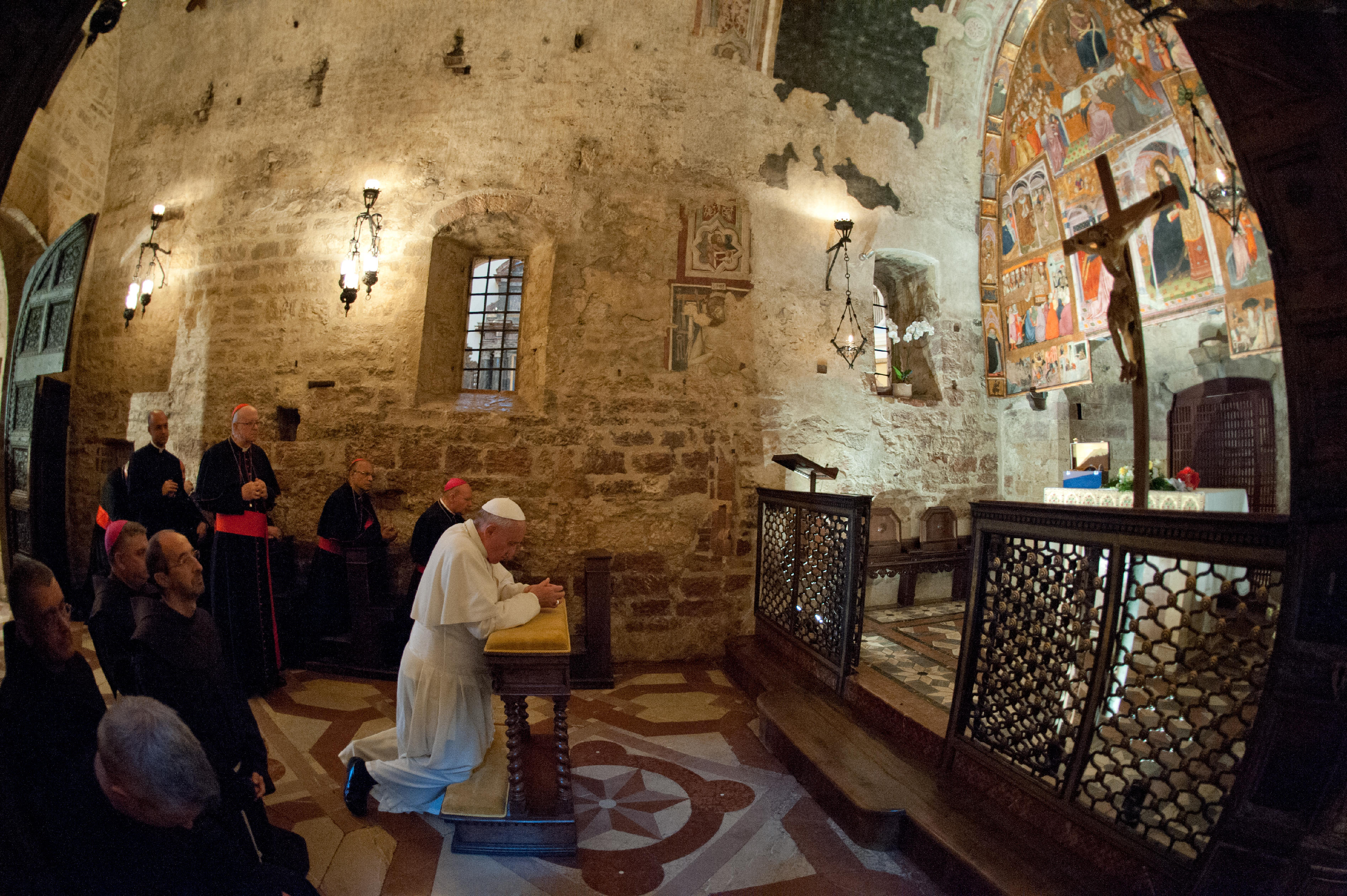
Pope Francis, a pilgrim on October 4 in the town of Assisi, through direct contact with the land whose name he decided to take after, fulfilled his desire. Now that name is enriched with content, and it gains ever more truthfulness. We already knew the reasons. But he is more aware of it now, having acknowledged, along with the countless pilgrims arriving from world countries, that those sites still bear living memory, which mark people’s lives through the indelible messages carved there forever. Those who have followed the itinerary of the Pope and know even just the names of those sites, are aware of the evocative force of Francis’ life. Episodes that are distant in time gain new light whenever they are evoked in our thoughts and minds. In the choice of the Pope’s itinerary, the watermark of his message shines through and like Ariadne’s thread is capable of guiding the Church and the world towards the way out of the labyrinth it is ever so often caught into. In fact, as the Pope warns, it’s not enough to be “ashamed” as human persons and as Christians, for the tragic situation under everyone’s eyes, in distant and less distant places, referring to the Middle East and to Lampedusa. The Pope undertook this journey as all pilgrims do. He carried a light saddlebag with the essentials: the Word of the Gospel and the Crucifix of St. Damian. Here we find the two Francis and Assisi. It means to truly divest oneself not from merely material things but from mundaneness and pride, namely, from idolatry. A mundane Church is self-destructive. Such dispossession is demanded not only of priests and bishops or of the Pope: the Church is all of us. This is and must continue being Christian people’s lifestyle, and not the adoration of self-created idols. It is a Church that escapes mundaneness, described as lepers and cancer. Pope Francis almost whispered these words, he spoke them with a soft tone of voice, calm and intense, without inflections. And they touched deeply all those who heard them. They are like a soft breeze that reaches our hearts. Like when he orders silence and kneels down in prayer. He has a popular style that is marked by authenticity, concreteness and immediacy. No abstract, “brain-shrinking” thoughts. The audience throbs whenever he speaks. This is the Church that he designed in Assisi with gestures and words, centred on the figure of Francis, the real one, not the one fabricated by the media, described as an excited/fanatic pacifist or an ecologist ante litteram, supporter of a sort of a “pantheistic harmony with the energy of the cosmos”. The disciple of the Lord follows in his wake bringing with him his light yoke. This is Francis and this is how all Christians should be. “The love of the poor and the sequel of Christ in poverty are two elements endlessly bound together, two facets of the same coin”. In the meeting with a small group of friars in Saint Damian he told them, almost joking, not to become “adulterous” by betraying Our Holy Lady of Poverty. “Where did Francis’s journey to Christ begin?” is the question of Pope Francis. And where should the Church begin from? The jointly historical and theological answer is the Cross of Saint Damian. In this icon he finds the full meaning of the Franciscan experience. “On that cross, Jesus is depicted not as dead, but alive! Blood is flowing from his wounded hands, feet and side, but that blood speaks of life. Jesus’ eyes are not closed but open, wide open: he looks at us in a way that touches our hearts… When we let the crucified Jesus gaze upon us, we are re-created, we become “a new creation”. Everything is born from the encounter with the Cross, also the invitation to renew the Church, that it may be divested to be authentic and free, poor for the poor. A Church that is able to cry for the victims of the shipwreck, that suffers for those marked by the scourge of Christ just like the poor in the Franciscan Seraphicus, and that is their servant. This is true Christianity: uncorrupted by the idolatry of material production, mirroring the icon that inspired Francis of Assisi to the renewal of the Church. On that occasion it could be said that Pope Francis delved deeply in what he believes should be the model of the Church today, so that it may be truer, bringing truthfulness within contemporary men and women. It could be described as a revolution, starting with the contemplation of the wounds on the body of Christ, that leave a mark on the painful limbs of the persons in flesh and blood that the Pope embraced and from whom he let himself be embraced and kissed. It is not an ideological revolution, nor a change in laws or rules of behaviour. It a heart-warming feeling of humanity that enlightens our conscience. The Church “does not grow through the efficiency of proselytism”. It grows through the force of attraction. That strength is love, “the love of God incarnate, a love which does not die, but triumphs over evil and death”. A heartfelt appeal to peace, “on the day of sorrow”, a blessing and a prayer for Italy, of which Saint Francis is the Patron Saint, a salutation to the homeland of St. Francis, Umbria, that gathered with the representatives of all its institutions in a large crowd of enthusiastic and moved faithful and citizens. A warm embrace with thousands of young people crowned the day that remains historical for the Church as a whole, because Francis is the Bishop of Rome and Pope.