ITALY" "
A preliminary balance of the Catholics’ Social Week in Turin

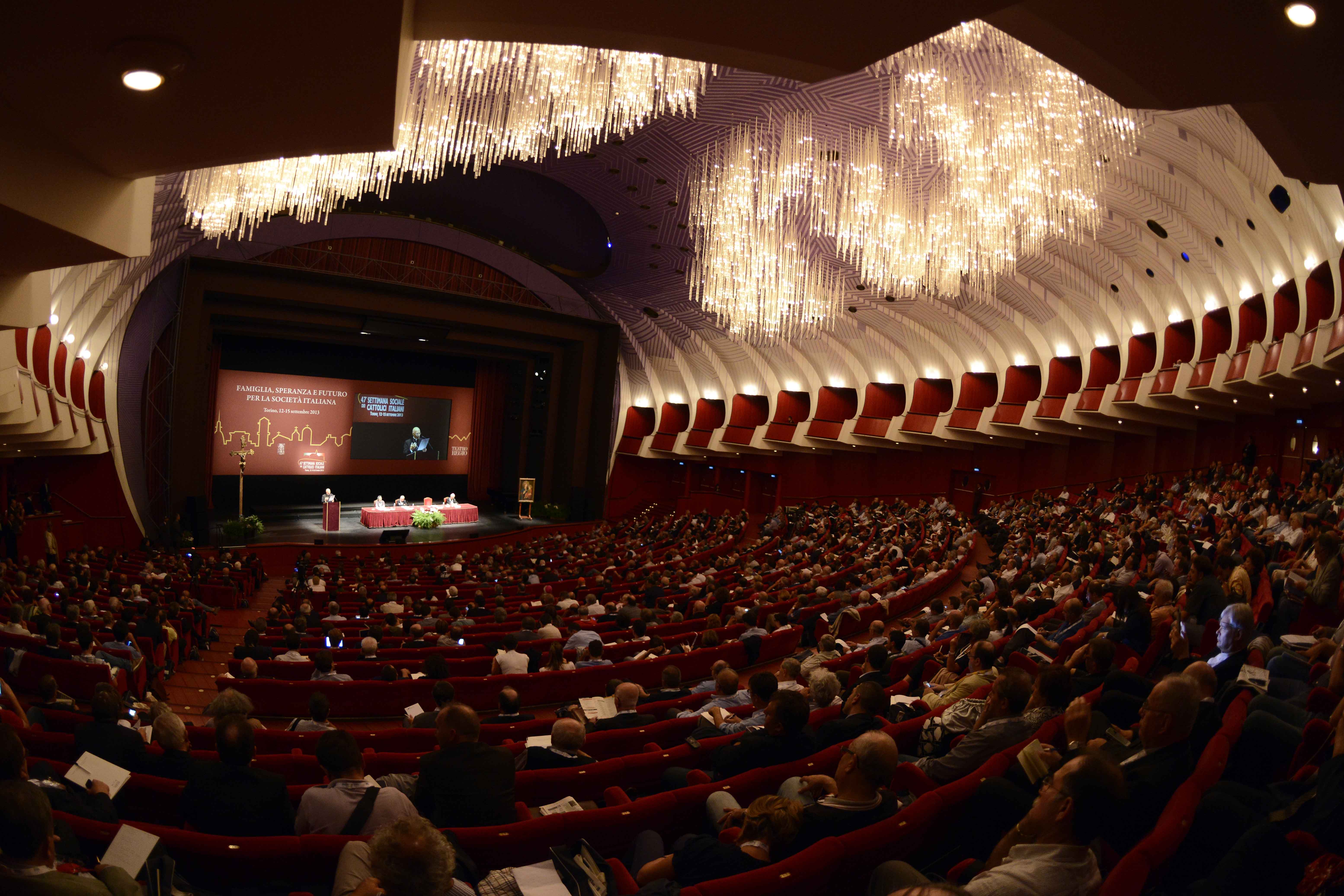
“Courage, along this road with the families!” It is the greeting, full of enthusiasm and affection, addressed by Pope Francis at the end of the Angelus prayer of September 15 to some thirteen-hundred participants in the 47th Social Week in Turin, that opened with the Pope’s message and continued with the prolusion by cardinal Angelo Bagnasco, president of the Italian Bishops’ Conference. A point of non-return. Upon the conclusion of the Sunday gathering with the faithful in St. Peter’s Square the Pope ideally joined the faithful in Turin by mentioning the theme of the Week and rejoicing over “the major commitment of the Church in Italy with the families and for the families, a major thrust for institutions and for the entire Country”. The Family and the Country, a joint concept that strongly echoed from the Teatro Regio in Turin, reiterated in the words of Francis: “The family is not a private business”. It is the “first conclusion”, the “point of non-return of our journey”, said Luca Diotallevi, vice-president of the Organizing Committee of the event. And most important, “it brings us to introduce a righteous element within Italian public debate”. The meeting will resume in 2017, announced the President of the Social Weeks’ Organizing Committee Msgr. Arrigo Miglio, to continue the journey that began over a century ago, whereby Toniolo and the city of Turin have been significant outposts. Yesterday just like today lay Catholics are still the protagonists, called to carry out their “good battles” with “the competition of freedom”. Follow the highlights of the Week. The Pope and the Cardinal. On Thursday September 13 the session began with the message by Pope Francis and the prolusion by cardinal Angelo Bagnasco. “A population that does not take care of the elderly and of children and the young has no future”, the Pope said drawing a portrait of the family rooted in Genesis, which presents “unity in the difference between man and woman”, that thrives on fruitfulness. Echoing the Holy Father’s words, Cardinal Bagnasco’s prolusion focused on the “rock of difference”, challenged by “gender theories” that risk “trouncing” the natural family based on marriage, to the point of questioning its very survival. Another danger, the Cardinal said, is “generational segregation”: the family experience is put to dire test by “the obscurantism of inter-generational differences”; “picking up the threads of generational bond is important more than ever before”. Speeches and workshops. The second day of the Week was characterized by eight thematic workshops, preceded in the morning by a plenary meeting with three keynote speeches Lorenza Violini, professor of Constitutional Law at the University of Milan, provided an understanding of the family rooted in the Constitution: “All reflections on law should be based on the question of who is the human person”, she said denouncing the “attacks” on the family by the secular realm. “An ageing society, leading to increasing unbalances”, with “disoriented” and “distant” youths is the snapshot of Italy according to Giancarlo Blangiardo, professor of Statistical Sciences at the University of Milan Bicocca. In the coming years Italy will be called to face “a dramatic decrease in production potential”, he said, adding that in national welfare will depend on “transformations in the family structure, linked to population ageing”. Some proposals. “The family is bound to recover its central role in welfare policies, for the Country’s development”. Such a “politically incorrect” forecast, taken for granted “not in the short, but in the long run”, was presented by Stefano Zamagni, Professor of Economic Policies at the University of Bologna, for whom “the outdated slogan, reiterated incessantly since the 1980s, whereby ‘the family is over and gone’, has no meaning today”. The thematic workshops were the main item on the agenda of Sunday 14th. Proposals include, inter alia, an Italian “new deal” for the family; recognizing the families’ “social contribution” to the State; reviewing tax burdens on families; promoting equality of school qualifications and promoting youth job placement through “integrated strategies” along with targeted and improved education.
