CCEE" "
Church communicators convene in Lisbon. A session on the Synod on the Family

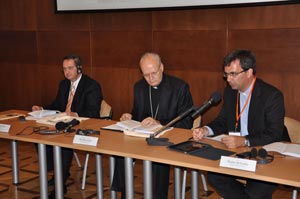
Since his election Pope Francis “has had a strong presence in the media”. Every single day, in fact, the Pope “appears in the newspapers all around the world, fills the pages of Facebook, and is the subject of many tweets. But his communication is “not the result of media strategy. It is made of simple but always significant words and gestures, which were able to fill the gap with people, and show the Pope’s proximity with individuals and world populations”. This year’s meeting of the spokespersons and press officers of European Bishops’ Conferences took place in Lisbon June 11-14, promoted by CCEE (Council of European Bishops’ Conferences). The final statement highlights the major themes addressed – the communication by Pope Francis and the Synod on the Family – by some fifty participants from all over Europe. During the meeting the spokespersons listened to personal accounts on the difficult situation of the population of Ukraine and Bosnia-Herzegovina; reports on the activity of the Commission of the Bishops’ Conferences of the European Community, (CCEE), of the Commission of Bishops’ Conferences of the European Community, and of SECAM, (Symposium of the Bishops’ Conferences of Africa and Madagascar). Words, gestures, signs. “Habemus Papam has been a global event with record-breaking ratings. In Austria it was the TV programs with the most watched TV broadcast in 2013”. The spokesperson of the Austrian Bishops’ Conference Paul Wuthe, proposed some insights for debate on the theme of the “Pope as a true gobal communicator”, underlining three aspects: Bergoglio as a “media phenomenon”, risks and opportunities linked to this theme and the “consequences” for church communicators. “The Holy Father knows how to transmit the Christian message with every-day, basic language, that everyone can understand. The message is thus captivating”. Not only: “The Pope also communicates with gestures, signs, with images that do not need – added the Austrian journalist – to be translated. “But what makes Pope Francis even more “communicative”, according to Wuthe, is “his personal credibility. For this reason, his testimony is immediate, direct, never abstract”. His “narrative style” is made of words and behaviors, including “his habit, the fact that he takes the coach with the Cardinals or that he chose Santa Marta as his place of residence”. Wuthe pointed out that “sooner or later, as natural, media interest will decline” and it is possible that “some of his messages may be misunderstood” or “manipulated”. Church communicators must therefore be “exhaustive”, seeking to convey “accurate accounts of what the Pope says and how he says it”, “always contextualizing his message”. Focus on the family. In Lisbon, Church communicators, with the help of Cardinal Lorenzo Baldisseri, Secretary General of the Synod of Bishops, and Father Federico Lombardi, director of the Vatican Press Office, also made a special preparation to communicate the forthcoming Extraordinary Assembly on the Family. “Announcing the Synod is always a special event; announcing an Extraordinary Assembly, that will involve a large number of presidents of Presidents of Bishops’ Conferences in Europe and worldwide, is a special event that requires utmost dedication on our part”, Thierry Bonaventura, CCEE press officer, said in his opening address. “If this Assembly addresses the theme of the family, institutions whose traditional forms are increasingly being questioned in many Countries and which in others is not valued as the object of in-depth reflection or government support, then this event becomes an urgency for all of us”, which explains why this issue was given a major role within the Assembly. Focusing on transparency. The synod on the Family – is in fact a multi-step process that has “activated several components” of the Christian community. “It began by handing out a questionnaire that was not to be understood as a survey on the Family conducted by the Church but rather as a data-collection on pastoral models and on the challenges the family is called to face in contemporary society, marked by prevailing individualism”. As planned, the Synod on the Family will release a working document (Instrumentum laboris) due to be issued by the Synod, which will constitute the basic document for the reflections of participants in the Extraordinary Assembly (October 5-19). The Bishops’ Synod on the Family, due to take place in 2015 will represent the closing assembly of this two-year process. From the debate emerged the “image of a Church will also in this realm aims at transparency of action, which does not fear debate, ready to listen to the challenges of history”, giving renewed emphasis to the “Good News of Christ to the Christian family as a true source of hope and new life”.
