CHURCHES IN BRIEF

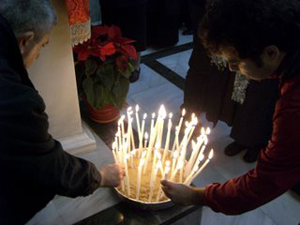
Germany: day of prayer for persecuted Christians Next December 26 German Catholics will live a “Day of prayer for persecuted and oppressed Christians”, addressing their prayers especially to their brothers and sisters in the world victimized for their faith in Christ. The date was chosen by the German Bishops’ Conference, DBK, as it marks the celebration of the feast of St. Stephen, first martyr of Christianity. Recent statistics mention over 100 countries where at different levels Christians suffer from persecution, mistreatment or discriminations. The situation of Christians in Iraq is even more dramatic. All churches in Germany will convey their solidarity with prayers and intercession. Instructions and prayers for the community of faithful are available on the website www.dbk.de. A manifesto bears the details of the initiative in the light of the German Bishops’ determination “to step up parishes’ commitment for discriminated Catholics worldwide”. Spain: Homes of the Seminary, reception and inclusion The President of the Agency for Housing in Catalonia, Carles Sala, and the vicar general of the diocese of Lleida, Monsignor Ramon Prat, have signed a joint agreement to support the financing of the Seminary Homes. This collaboration will bring 50 thousand euro, which serve to implement the project. But the sum could increase in the coming years if the Seminary Houses are classified as accommodations for inclusion, explained Carles Sala during the signing of the agreement. The President of the Housing Agency praised the project of the Seminary Homes, which he described as “exemplary and inspiring”. The vicar general of the diocese of Lleida highlighted three positive aspects of the agreement: “First of all, it is a model of cooperation between administrative institutions and society, aimed at the common good”. Second, “the project of the Seminary Homes has enabled many people to work together in different ways and on a voluntary basis, optimizing synergies”. Finally, Monsignor Prat, welcomes the project’s objective of concentrating in the same building the cultural world – in fact, it is situated in a wing of the Higher Institute of Religious Sciences – and the world of the poor. “All in the same house, inseparable, as the Eucharist and charity”. Slovakia: charity with the “Good news” project The “Good News” project, the largest charity campaign organized by the Association of Communities of Christian children in Slovakia, will celebrate the 20th anniversary of its creation. The main purpose of the initiative is the collection of funds to help children in developing countries in Africa. The title of this year’s edition is “The Good News changes my life”. In addition to the financial aspect, all participants and donors are invited to stop and reflect on the idea of charity in general and on the related benefits not only for those who receive help but also for those offering it. “Not only does the project exert a positive influence on the lives of people living in African countries, it also impacts the lives of volunteer cantors who bring the Good News to all parishes and families, as well as those who give financial contributions”; said the chairman of the association, Juraj Kralik. He added that the “Good News” campaign, promoted over twenty years ago, has grown into the largest volunteering campaign in Slovakia thanks to wide support by the public opinion. Last year cantors collected over 900 thousand euro, as “a token of the fact that despite their problems donors are not indifferent to the destiny of poor people”. Czech Republic: document on liturgy and music A list of recommendations for the use of liturgical music was recently published by the Czech Bishops’ Conference, with particular attention to specific music styles used by young people. “In recent years we have noted some tensions and misunderstandings between liturgists, musicians and lay people, especially among younger people”, states the preface by Msgr. Pavel Posad, delegate of the Bishops’ Conference for Youth Ministry. The document, 25 pages in all, reminds readers that all styles of liturgical music are an “integral part of the liturgy”, and that musicians should be aware of this during performances and when composing liturgical music. The prelates stress the need for ongoing training in this area and compliance with requirements. “I believe that this document represents another important step on the way towards the beauty and nobility of the liturgy, which deserves extraordinary attention on our part because its purpose is to celebrate God, raise every human being so that he/she may unite with his/her source, sanctify the faithful and contribute to the salvation of the world”, said Msgr. Posad.
