EDITORIAL/1
In the Pope’s addresses to institutions in Strasbourg questions and milestones to revive peace, rights and dialogue with citizens

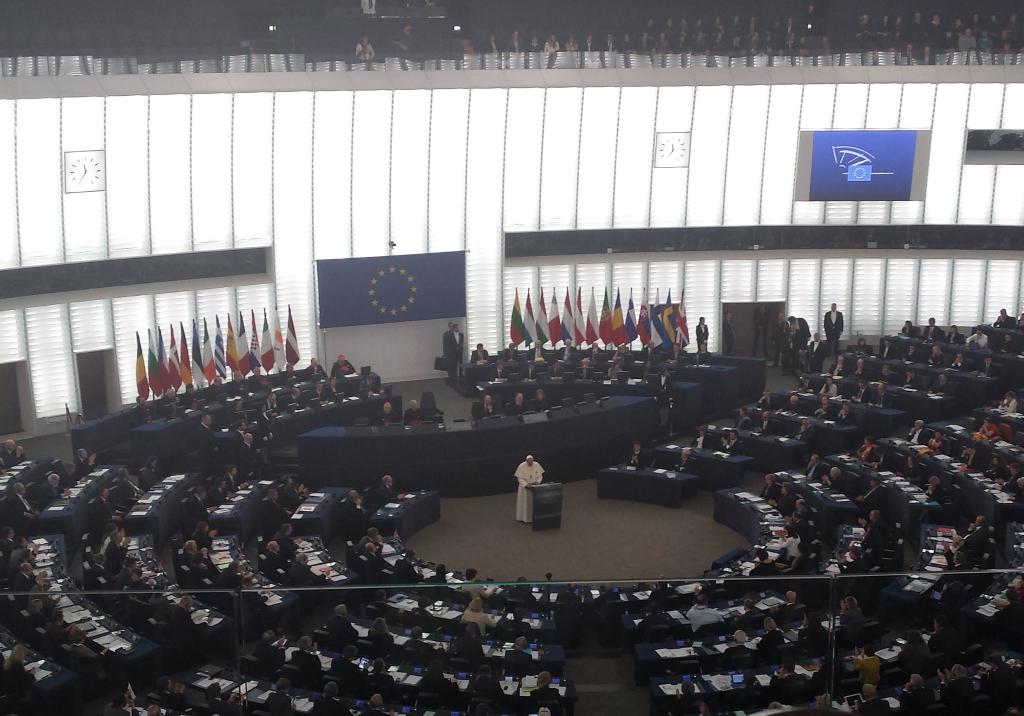
In his four-hour visit Pope Francis embraced the entire European continent! In Strasbourg, in the seat of the Council of Europe and of the European Union, the Holy Father delivered two long speeches (over half-hour each) marked by intense and significant content, which now deserves reflection and implementation. In both cases, the hemicycles were crowded with people of all shades of political opinion and from all European countries. In a certain sense, due to their institutional role, those present represented all the inhabitants of our continent. Through them, the Pope intended to speak to all European citizens. It should be remembered that the European Union brings together 28 States, which, through various treaties, converges their interests – notably economic interests – and strengthen, for this reason, the States’ mutual solidarity. In the Council of Europe, created immediately after the Second World War, are represented 47 states tasked with promoting policies and legislation mindful of the respect of human rights and with ensuring the continuation of peace. The Pope has clearly indicated some issues that must become priorities on the European stage. But before that he presented the criteria for a true human policy. In the EU Parliament he said in clear words that it is necessary to put the “person with a transcendent dignity” at the centre of policies. The person, therefore, and not just the economy, has increasingly become the main political criterion. The dignity of the human person – and consequently human rights based on the nature of the human person – is the goal to be pursued, as the Pope later noted in his address to the Council of Europe, also in relation to peace building. To this regard the Pope’s call not to succumb to an individualistic, consumerist society has had a strong impact. Individualism triggers a culture of waste, in which some people are “worth more” than others. There is an urgent need – we may conclude from the Pope’s words – to take the common good into our hands, with special attention to young people in search of a job, old people living alone, sick people often forgotten, children who are not yet born… Another firm point for Europe’s future is the concept of multi-polarity. There is a hot debate on unity and diversity in Europe. How can true and fruitful unity be ensured without dissolving the identities of different peoples, but rather strengthening the richness that each person can bring to the whole? Using the image of the polyhedron, the Pope highlighted the importance of respecting diversity in order to ensure fruitful, enriching, solidarity, that leads to authentic unity. Europe needs to be a “”amily of nations” where each one has and retains his/her identity, physiognomy and function. It is to be hoped that the Pope’s words may become the object of study, in-depth reflection and dialogue between civil society and the institutions. The Pontiff, in his part, reiterated that the Church is open and committed in the dialogue with everyone, namely, also with European institutions. For this reason Pope Francis pointed out that COMECE (Commission of the Bishops’ Conferences of the European Community) is an interlocutor for issues of interest of the European Union, and that CCEE (Council of European Bishops’ Conferences) is available to tackle the manifold issues that the Council of Europe is called to address. It is evident that the Pope’s visit has confirmed the Church’s belief in the importance of European bodies. But the Pope recalled what many people think regarding the need for a change in culture and values inside the European Union and within the Council of Europe. But it is not related to pessimism: the glace of faith always triggers hope, although it entails a conversion. In fact, since the beginning of his pontificate Pope Francis has been encouraging Europeans to be open to the grace of God and thereby lead a fuller and more authentic life. From this perspective the questions the Pope asked to Europe on November 25 deserve further reflection: “Where is your vigour? Where is that idealism that inspired and ennobled your history? Where is your spirit of curiosity and enterprise? Where is your thirst for truth, a thirst which hitherto you have passionately shared with the world? The continent’s future will depend on the answer to these questions.
