COMECE
European bishops at the memorial of Douaumont commemorating the victims of one of the most tragic episodes of World War I

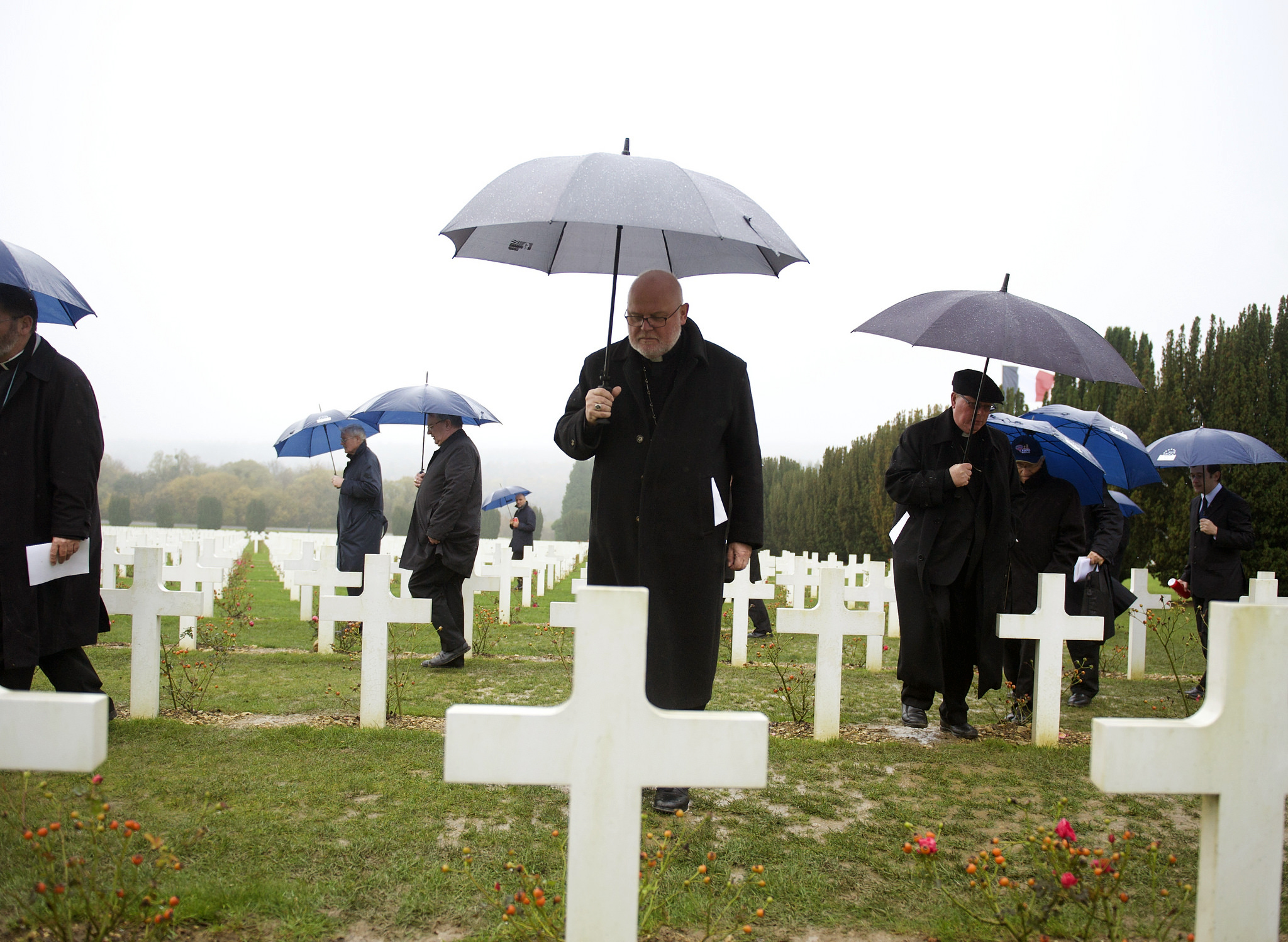
An immense stretch of land with thousands of white crosses; it’s raining hard and it’s cold in Douaumont, a city in the north of France, a few kilometers away from Germany. Here stands the largest Memorial of the First World War in Europe. On this land was fought one of the bloodiest battles of the Western front. It is recorded in history as the “Battle of Verdun”. It broke out on February 21 1916. It ended, after various stages, on December of the same year, revolving around the hostility between German and French armies. They were all young men in their early twenties. Many of them didn’t even know against whom and what they were fighting. That battle claimed the lives of nearly one million soldiers. Cherishing the memory. European bishops convened here, at Douaumont’ Memorial, on November 11, to pay tribute to the memory of this tragic historical chapter of blood and death, to ask forgiveness for the sins committed by Churches in that period and to tell contemporary Europe to take to heart the memory of that tragic lesson of the past. They arrived from Germany and France, Bosnia and Herzegovina, Malta, Romania, Italy, England… The bishops’ delegation was led by Cardinal Reinhard Marx, Archbishop of Monaco and Freising, president of the Commission of the Bishops’ Conferences of the European Community (COMECE), and by Cardinal Vinko Puljic, Archbishop of Sarajevo and President of CCEE. Healing the wounds. The bishops silently came together in the heart of the military cemetery where lie the remains of some 130 thousand soldiers from the opposing fronts, they stood in a circle under the pouring rain and prayed in different languages. Then they lit votive candles and placed them before the altar of the chapel of the Ossuary. They read poems and recited the prayers against the backdrop of the images of the multiple armed conflicts that are still being waged in Europe and in the rest of the world, from Ukraine to the Middle East. “We are conscious of the importance of healing the wounds of war through the force of faith, and to pray for the establishment of long-lasting peace”, said cardinal Vinko Puljiæ of Sarajevo. “Today’s prayers are a cry to heaven to enlighten man, free him from hatred and ask that he be respected in his dignity and rights. And likewise should be respected every nation and every religious community. With a special cry we pray to stop the persecution of Christians, to work toward coexistence and reconciliation”. “Never again…” The role of Churches today is to mark the memory of the past in Europe, which easily lets go to the oblivion of its history. Just by re-reading those pages in black and white can contemporary Europe progress on the path of peace. Of that past, the bishops make mea culpa and ask forgiveness for all the times they supported nationalism and endorsed the meanest death plans. Nobody can pull back from his responsibilities. A historical reconstruction by COMECE on the First World War shows that the Churches of France, Germany, Great Britain and Russia have supported the war often describing it as “holy”. “As bishops, today – said Cardinal Reinhard Marx – we feel how important it is to ask for forgiveness, because the Churches were not instruments of reconciliation but instruments of hate and division. To make memory of the past is to say: never again will the churches, the bishops, the Christians, become instruments of war and division. People are brothers to each other and members of the one family”. Hope. The day of pilgrimage ended with the presentation of a final message of peace that the bishops addressed from the heart of the tragedy of Verdun to the entire European continent. “What strikes us again is the sheer folly of war and the pity of it all”. “We speak for all the victims of war and armed conflicts, military and civilian, and we pray for peace in the world”. The message conveys a joint plea for forgiveness: “We soberly recall how even churchmen stoked the fires of conflict and fuelled nationalist passion: it is a recollection tinged with regret and shame”. “Our visit of pilgrimage to Verdun makes us, as bishops, more resolute in our commitment to assist Europe in recovering the Gospel roots of its identity, to appreciate anew the values – many of them profoundly Christian – which bind her as a community, and to promote a future for all Europe’s citizens and for the wider world where peace and justice reign. Inspired by the joy of the Gospel message, our gathering closed with a hope: the hope of a future of peace for the whole of humanity”.
