THE POPE IN STRASBOURG
The President of the EU Parliament Martin Schulz, in the Vatican to define the details of the November 25 visit

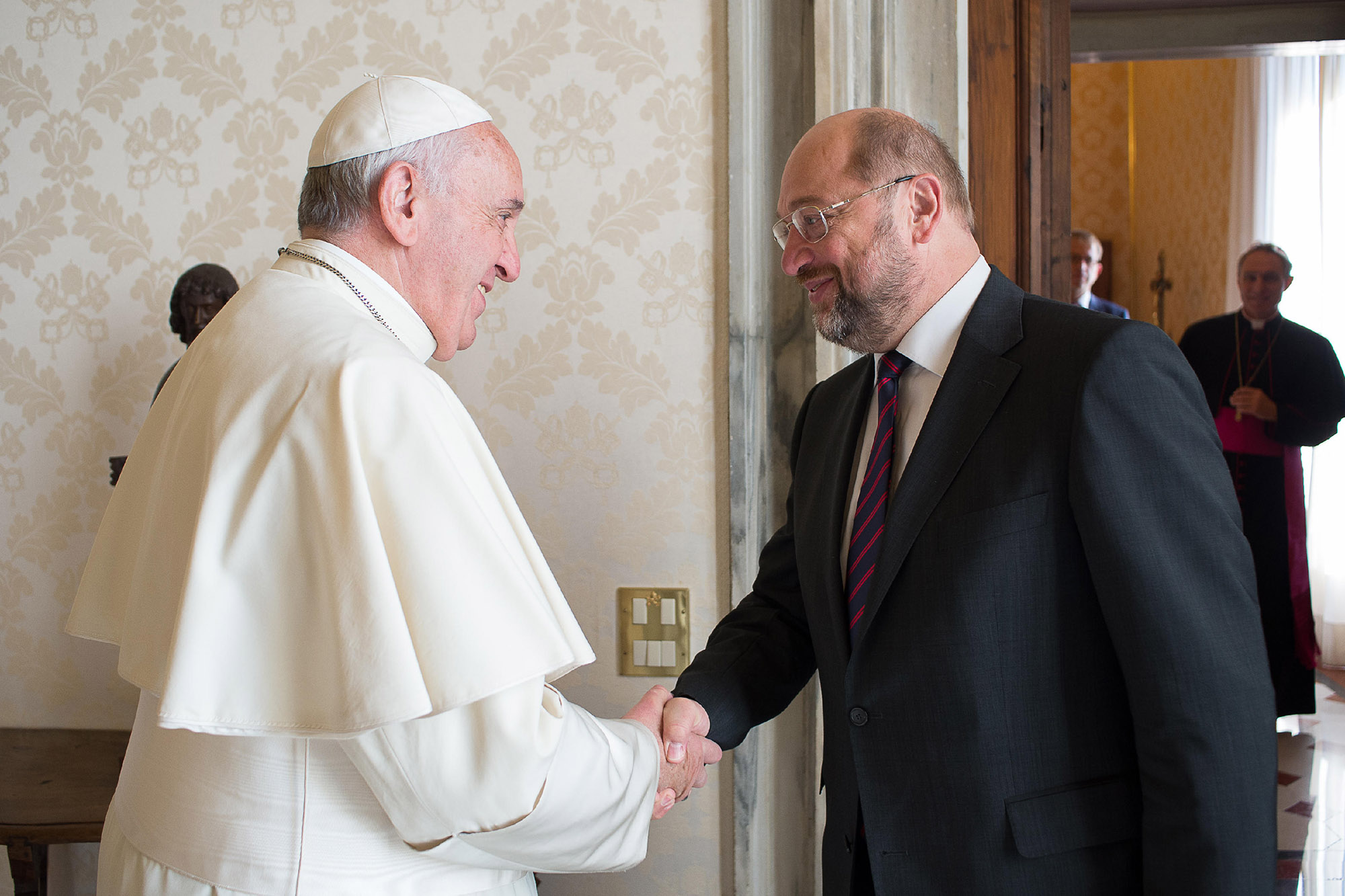
Growing expectation for the visit of Pope Francis to European institutions, scheduled for November 25. The President of the European Parliament Martin Schulz was in the Vatican October 25 to define the details of the day’s agenda, where he was received by the Pope and by the Secretary of State, Cardinal Cardinal Pietro Parolin. “Extremely interesting meetings”, Schulz said before a cup a coffee, and went on to discuss also the European integration process and the worrying situation at international level. Before and after the Berlin Wall. “It won’t be just a visit at the European Parliament in its seat in Strasbourg. It will be a meeting will all EU institutions”: the German politician detailed the agenda of November 25, that envisages the Pope’s speech at the European Assembly Hall to the presence of MEPs and of “representatives of European Council and Commission”, followed by at the Assembly Hall of the Council of Europe. “It will be an exceptional occasion”, Schulz pointed out, with the reminder that the previous visit was by John Paul II in 1988. “But since then, scenarios have changed completely”. “At the time, ECC comprised 12 Member countries, it had limited responsibilities, and Europe was still divided” into two blocs. “Today the European Union has 28 Member Countries, with 500 million inhabitants, increased roles and powers” as provided for by the Treaties stipulated over the past 25 years. “In the meantime the Wall of Berlin has fallen”, thereby enabling enlargement to the east, as Pope Woityla had hoped for. Now there is great expectation over the themes that will be addressed by Pope Francis: from the economic crisis to the prospects for young people, from solidarity between nations to interventions in favour of migrants and refugees… The role of the Churches. Martin Schulz – a major figure of SPD, German Social-Democracy – recalled that “an invitation to the pontiffs” for a visit to EU institutions “had already been addressed by my predecessors Poettering and Buzek”. In the hemicycle the Pope “will address not only MEPs and EU leadership but also all the peoples of Europe, represented by MEPs elected with universal suffrage. Indeed, the dialogue between Churches and Community bodies – open, transparent and regular – is stipulated in the Lisbon Treaty: in your opinion, is it a constructive relationship? “Yes, it is – Schulz told SIR Europe -. Moreover, referring to my personal experience as mayor of a city with 40 thousand inhabitants, the presence of religious communities benefits society, as it is a lively presence” experienced in the field of solidarity, education, cultural debate. International scenarios. For Schulz the Pope’s visit to Albania, the Pontiff’s first visitation in Europe, “is very significant”. “He chose a ‘peripheral’ Country, which is also a young Country marked by the presence and co-existence of a large number of religious communities”. For the president, Bergoglio’s visit to Turkey, a few days after his visit to Strasbourg, is equally important. Here Schulz assumed a more sober look, choosing his words carefully. The Erdogan government is in a delicate situation, torn between support to those fight for freedom, as the Kobane curds, and those considered State enemies. But the Caliphate “is a threat to everyone, it’s an unprecedented form of terrorism”, which wishes to take the shape of a State whilst failing to respect international law and minority groups, including the religious minorities in the Middle East. “A solid regional alliance is needed” that will involve neighbouring Countries, to which the EU could give diplomatic, concrete support. The future of Europe. Past Sunday, Tunisia and Ukraine went to the polls: do you think that democracy is approaching European neighbours? “As for Tunisia it should be said that the result was encouraging, with the victory of a lay movement” in a Country where there is also an Islamic political force. “It shows that democracy works, that a correct dialogue between political forces is under way. Now we are looking forward to a coalition government” that will assure a future to the Country. Will the EU sit and watch? “In the past, Europe found large sums of money to finance the dictators” of the Arab Spring Countries. “I hope that the same amount of funds will be allocated to support the strengthening of these democracies”. Expectations are high also for the situation in Ukraine: “The outcome of the polls showed there is a strong pro-European majority. Rada is the legitimate representative of all Ukrainians, and I hope that also Moscow will recognize it, respecting the territorial sovereignty” of Ukraine. “We now need a government that will face people’s concrete problems”. There is time for a last question: on several occasions the Pope spoke of a tired Europe, what’s your opinion? “I think the Pope is right”. The debate then extended to demographic ageing, the lack of jobs for young people, the consequences of the crisis, widespread nationalism, along with a reference to “the need to invest, and sustain real economy”, to promote growth, relying on Juncker’s promised 300 million investments package. But this is another chapter…
