SYNOD
The Pope’s encouragement to continue spiritual discernment ahead of the ordinary Assembly on the family in October 2015

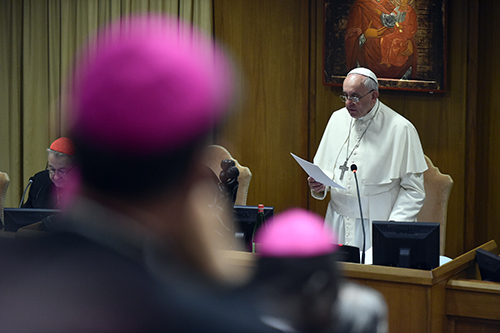
“Now we still have one year to mature, with true spiritual discernment, the proposed ideas and to find concrete solutions to so many difficulties and innumerable challenges that families must confront; to give answers to the many discouragements that surround and suffocate families”. With these words Pope Francis closed his intense, passionate speech – the only one, following his opening address – at the end of the extraordinary Synod on the family, welcomed with five minutes of applauses, marking the conclusion of two weeks of work (October 5-19). Francis reminded the Synod Fathers that there is still one year – until the celebration of the Ordinary Synod on the Family (October 4-25 2015) – to work on the “Relatio Synodi”, the final document of this first stage of the Synod, voted as a whole by a majority of 181 Synod Fathers present, with some abstentions. With open doors. With an unprecedented decision, the Pope has not only authorized its publication, he also established that the results of the individual voting on each point of the “Relatio” be made available to public, along with the number of votes in favour and those against. The overall purpose is “transparency and clarity, so as to avoid confusion or misunderstandings”, said the Vatican spokesman, Father Federico Lombardi. Thus the document was approved in the assembly Hall, with a vote on each of all 62 paragraphs, with a qualified majority. Three points – paragraphs 52, 53 and 55, regarding access of remarried divorcees to the Eucharist, the proposal of “spiritual communion” and homosexual unions – were not received by a qualified majority but only by an absolute majority vote. As compared to the “Relatio post disceptationem”, the “Relatio Synodi” is a broader text, whose purpose is “greater balance and development”, Lombardi pointed out. The perspective, the Pope said in his speech is not that of a Church “that doesn’t see humanity as a house of glass to judge or categorize people”. It is the Church “that is not afraid to eat and drink with prostitutes and publicans. The Church that has the doors wide open to receive the needy, the penitent, and not only the just or those who believe they are perfect!” Avoiding temptations. Five “temptations” need to be avoided, listed by Pope Bergoglio. The first is “a temptation to hostile inflexibility”, that is typical of “traditionalists” and and also of the intellectuals. The second is “the temptation to a destructive tendency to goodness”. It is the temptation of the “do-gooders”, of the fearful, and also of the so-called “progressives and liberals”. The third is “the temptation to transform stones into bread and also to transform the bread into a stone”. The fourth is “to come down off the Cross, to please the people”, bowing down “to a worldly spirit”. Finally, the fifth is “to neglect the ‘depositum fidei’, or, conversely, the neglect the truth making use of a language of “byzantinisms”. “Personally I would be very worried and saddened if it were not for these temptations and these animated discussions” at the Synod, the Pope said. “if all were in a state of agreement, or silent in a false and quietist peace. Instead, I have seen and I have heard – with joy and appreciation – speeches and interventions full of faith, of pastoral and doctrinal zeal, of wisdom, of frankness and of courage: and of parrhesia”. “And this is the Church, who is not afraid to roll up her sleeves to pour oil and wine on people’s wounds”. Each family, all families. “Truth and beauty of the family and compassion toward wounded and fragile families” is the paragraph of the “Relatio Synodi” that links the second and the third part. “The Church looks to the families who remain faithful to the teachings of the Gospel, encouraging them and thanking them for the testimony they offer”, states the document. The Church “turns with love to those who participate in her life incompletely, recognizing that the grace of God works also in their lives by giving them the courage to do good”. As regards remarried divorcees the question of “a penitential” for access to sacraments “deserves in-depth reflection” bearing in mind “the distinction between the objective situation of sin, and attenuating circumstances”. Care of civil marriages. “A new dimension of family ministry today – is underlined in the Relatio – is to pay attention to the reality of civil marriages between men and women, to traditional marriages and, given due differences, even to cohabitation”. “When the union reaches remarkable stability through a public bond, is characterized by deep affection, by responsibility with respect to offspring, by the ability to overcome ordeals, it can be seen as an opportunity to be accompanied in the development of the sacrament of marriage”. As for homosexual unions, the focus was on which is the best form of pastoral care to deal with this situation with reference to Church teaching: “There is no foundation whatsoever to assimilate or to establish even remotely analogies between homosexual unions and the plan of God for marriage and the family”.
