SYNOD" "
“Recognizing positive elements also in imperfect forms outside” sacramental marriage

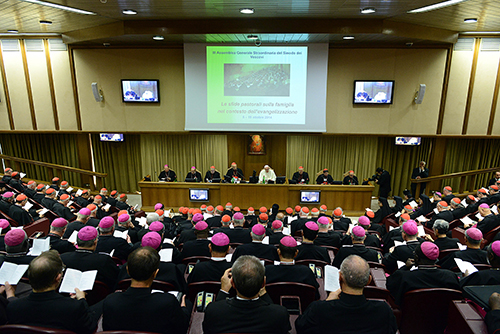
“A new dimension of Family Pastoral Care today consists in grasping the reality of civil marriages, and given due differences, also of cohabitation”. It’s an inclusive perspective, that begins with the “law of graduality” adopted by the Synod fathers in the “Post-discussion Report”, read in the Assembly Hall by Cardinal Peter Erdõ, general relator of the Extraordinary Synod on the Family, to the presence of the Pope and of 191 Synod fathers. The logic to be adopted is “the art of accompaniment”, not that of “everything or nothing”: the line chosen is that of the Council, where it is stated “only one Church of Christ subsists in the Catholic Church”, although “many elements of sanctification and truth can be found outside her structure”. Hence there is the need to “recognize positive elements also in imperfect forms that are to be found outside” sacramental marriage, opening up to “positive elements present in other cultures and religions”. Missionary Conversion. “The Church turns respectfully to those who participate in her life in an incomplete and imperfect way, appreciating the positive values they contain rather than their limitations and shortcomings”: with these words Cardinal Erdõ explained the “need for spiritual discernment with regard to cohabitation, civil marriages and divorced and remarried persons”. As regards the Church, “House of the Father”, “guiding light for the people”, the appeal is for a “missionary conversion” that may first of all be a conversion in language. “This is not merely about presenting a set of regulations but about putting forward values”. Ahead of the publication of the “Relatio Synodi” and the message, to be released at the end of the Extraordinary Synod, Cardinal Lorenzo Baldisseri, General Secretary, announced the theme and the date of the 4th ordinary Assembly of the Bishops’ Synod on the Family, that will take place October 4-25 2015 on the theme, “The vocation and the mission of the family in the Church and in the contemporary world”. “Exasperated individualism”. “The crisis in the couple destabilizes the family and may lead, through separations and divorce, to serious consequences for adults, children and society as a whole, weakening the individual and social bonds”. Today’s world “appears to promote limitless affectivity” to the benefit of “exasperated individualism”. Solitude and “affective fragility” prevail, along with “narcissistic affectivity”, while “couples are often uncertain and hesitantcouples are at times hesitant”. Increasing cohabitation. “It is necessary that in the ecclesial proposal, while clearly presenting the ideal” of marriage, “we also indicate the constructive elements in those situations that do not yet or no longer correspond to that ideal”, is the basic recommendation of the “Relatio”, which points out that in many Countries “an increasing number live together ad experimentum, in unions which have not been religiously or civilly recognized” and “there is an increasingly large number of those who, having lived together for a long period of time, ask to be married in the Church”. “Courageous choices” on remarried divorcees. “What rang out clearly in the Synod was the necessity for courageous pastoral choices” on separated couples, divorced and not remarried persons and remarried divorcees. However, “It is not wise to think of unique solutions or those inspired by a logic of “all or nothing”. “Renewed pastoral practices” are needed, to address in particular “the consequences of separation and divorce for children”. As regards the possibility of partaking of the sacraments, it could be preceded, valued on a case-by-case basis, “by a penitential path – under the responsibility of the diocesan bishop -, and with a clear undertaking in favor of the children”. “Welcoming home” for homosexual persons. For homosexual persons, the Church must be a “welcoming home”, reiterating that the Church “affirms that unions between people of the same sex cannot be considered on the same footing as matrimony between man and woman”. “Homosexuals have gifts and qualities to offer to the Christian community”, said card. Erdõ, exhorting to a conscience examination: “Are we capable of welcoming these people?”. “Without denying the moral problems connected to homosexual unions”, there are “cases in which mutual aid to the point of sacrifice constitutes a precious support in the life of the partners”. Furthermore, the Church “pays special attention to the children who live with couples of the same sex, emphasizing that the needs and rights of the little ones must always be given priority”. Open to life. “Realistic language” on openness to life. It is the indication in the final part of the Report that denounces “the spread of a mentality that reduces the generation of life to a variable of an individual’s or a couple’s plans”. “Openness to life is an intrinsic need of conjugal love”, recalled the prelate, calling for a “realistic language” to acknowledge “the beauty and the truth” of an unconditional opening to life. In this light, he added, “we should go back to the message of the Encyclical Humanae Vitae”.
