CHURCHES IN BRIEF

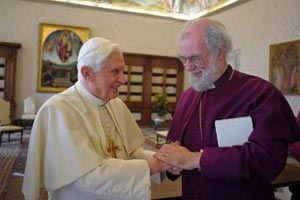
England: Anglican women bishops and dialogue “A further obstacle has been placed on the path to the unity of the Catholic Church with the Church of England. Nevertheless we are committed to continuing our ecumenical dialogue, along with the goal of full visible ecclesial communion”. The Bishops’ Conference of England and Wales (CBCEW) thus commented on the decision of the Anglican Synod of York to proceed with the ordination of women bishops in a statement signed by Archbishop Bernard Longley, Chairman of the Department for Dialogue and Unity Catholic of the CBCEW. “We note and appreciate the arrangement of pastoral provision, for those members of the Church of England who continue to hold to the historic understanding of the episcopate shared by the Catholic and Orthodox Churches”, said Monsignor Longley. “We affirm again the significant ecumenical progress which has been made in the decades since the Second Vatican Council and the development of firm and lasting friendships between our communities”. Since the Church of England ordained the first woman bishops 20 years ago, hundreds of pastors and lay people have decided to embrace Catholicism. In fact, some evangelical groups as well as Anglo-Catholics oppose the ordination of women as they hope in a reunification with the Church of Rome. With the Apostolic constitution “Anglicanorum Coetibus” Benedict XVI established the ordinariate of Our Lady of Walsingham, enabling Anglicans to become Catholics, while preserving some of their liturgy. Caritas Germany: “too many school dropouts” “Some 47.600 young people have dropped out of school in 2012 without obtaining a diploma”, said the chairman of Caritas Germany Peter Neher, presenting the annual Report on “Education opportunities at local level” on July 14. Despite a slight decrease – 6% in 2011, 5.6% in 2012 – every youth that leaves school short of obtaining a diploma is one too many”, Neher said. It’s hard to find a job in Germany without a diploma. The major reason for high-school dropouts, is not, as if often said, the financial situation of a given local administration. In fact, “figures clearly show that when the political realm, school institutions, employment offices and local economy cooperate, we are able to provide efficient support to youths who are tired of going to school”, Neher said. The Caritas survey pointed out that the gap separating Eastern and Western countries is still large. Austria: alarm for the situation in Senegal The president of Caritas Austria Michael Landau, recently visited relief programs in Senegal: in Guetndar, near the fishing village of St. Louis. Landau found “a tragic situation caused by climate change, and especially for the huge foreign fleets that massively operate” at sea that are impoverishing the local population and the maritime enviroment. Since 2006 thousands of fishermen have died on small vessels in the attempt of finding better living situations by crossing the Atlantic towards Europe. “European countries fish in the seas where these people live, who desperately seek refuge in Europe”, Landau told Austria’s Catholic agency Kathpress on July 14, foreshadowing an intervention in Senegal, where 700 thousand people are at risk of famine. A portion of the funds collected by Caritas next August will be given to Senegal and to cover the sustenance of 30 thousand Syrian children refugees: a child is fed with 7 euros a month. Spain: “a society that gives priority to children” “To renounce comforts and reach out to the peripheries that need the light of the Gospel” to accompany the victims of this “culture of waste, where Mammon is at the centre”. It is the mission of Caritas Spain, in response to the calling of Pope Francis, as written in the final statement of the 71st general Assembly that brought together 150 participants from national dioceses over the past few days. The document highlights the will “to build a society that has people at the centre”, and it “reaffirms the common values of solidarity and fraternity in favour of everyone, especially the weaker brackets”, along with the need to create “a global world without frontiers, where everyone, equal in terms of dignity and rights, belong to the same human family”. This can be done if everyone – public administrations, civil society, the market and individuals, assume their responsibilities for a fairer world. On its part, Caritas pledges to “go to the peripheries to support marginalized brackets and promote innovative and significant initiatives, which show that a life based on alternatives to economic and individualistic models is possible”. A further commitment “is to denounce situations of injustice, pain and suffering, while implementing concrete proposals that contribute to Gospel proclamation”.
