FRANCE
Father Prencipe, director of the Pastoral of Migrants for the French Church: “A sign of force by the government to its electorate”

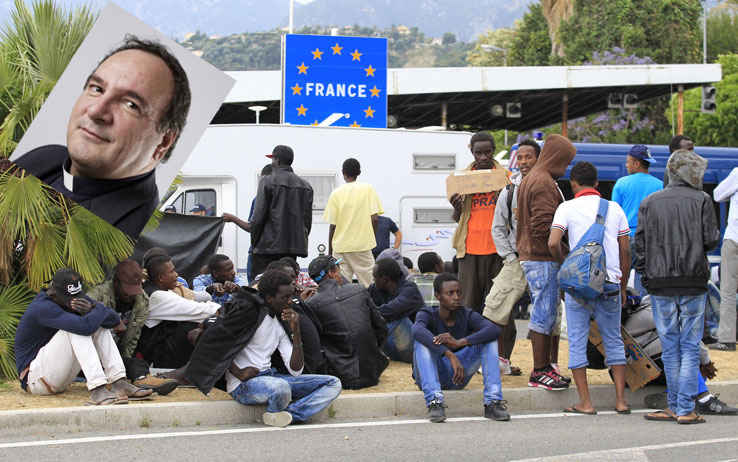
“We need to pass”. “We need freedom”. For days 200 migrants pushed back in Ventimiglia, on the Italian-French border, voiced desperate words of help to Europe that doesn’t want them and to France that refused their entry. Eritreans, Sudanese, Somalis, Ivorians reached Italy fleeing from their home countries. On 16 June the Italian police forcibly removed a large number of them: they were put on a bus and brought to temporary accommodation centers. But others refused to go back, camping out on the rocks in Ventimiglia, threatening to jump overboard. These images have been circulating worldwide, while on the same day, the interior ministers of Germany, Thomas de Maiziere, and France, Bernard Cazneuve, announced a new EU-scale willingness to solve the problem, combining – they stated – solidarity and responsibility. But the details of the “plan” are far from clear, while the distrust of all other EU Member States is yet to be overcome. Father Lorenzo Prencipe, director of the National Service of the pastoral care of migrants of the French Bishops’ Conference, views with concern this paradoxical situation. The colour of the skin. France has been keeping the borders with Italy under strict control since the period of the so-called “Arab springs. But now measures have been strengthened by sending police forces on the border of Ventimiglia to ensure that “nobody crosses the French border.” Until now the police had implemented random controls and refoulements. Now “they have decided to close to border” or more precisely – said father Prencipe – “no crossing is allowed to those with a certain skin colour”. The reason for these stronger measures is clear: “It is basically linked to the political situation in France”, which next year will go to polls to elect the President of the French Republic, as Hollande’s five-year term expires in 2016. It’s a volatile situation whereby the Front National is king, accusing the government of not controlling the borders. What has been happening between Mentone and Ventimiglia “is a sign of strength, to a certain extent a rather ridiculous sign – Principe pointed out – which the government is sending to the public opinion and to the electorate. While on the one side France thinks and describes itself as Europe’s driving force, on the other it ramps down all asylum and common migration policies. This is the core of the matter”. Political pranks. Thus, the border crossing is denied, forbidden and banned to whoever is without papers. Those without valid documents are rejected and sent back to the opposite side of the border. The implementation of such control procedures requires a request to suspend the Schengen agreements. At the beginning of the week Italian Premier Matteo Renzi furthered the proposal of a “B Plan” if “Europe shouldn’t choose the solidarity option”. Said plan envisages temporary visas to asylum-seekers thereby enabling them to cross the border and travel across Europe. The head of the Migration Service guards against the risk to propose “measures only out of spite between Italy and France, since it means gambling with migrants’ lives. In fact, we don’t know how the migrants will be treated by the French police once they cross the border, and not always journalists are on the spot to verify how they are treated or whether these temporary permits will be respected. If France understands that Italy’s stand is motivated only by the need to solve national problems it will adopt resulting measures”. Looking beyond the emergency. Also France is unable to cope with the situation. Only a week ago 350 asylum-seekers, and possibly refugees, were evacuated from the under the bridge of the subway in Boulevard de la Chapelle. Their presence was considered a problem for the city of “la vie en rose” that is preparing to open the summer season to tourists. “It’s not nice – said Fr Prencipe – to see open-air encampments. As it’s not nice to see them in Milan’s train station or at the Tiburtina train station in Rome”. “Everyone must do their share”, is the request of the religious. All of us, Christians and ecclesial communities alike, cannot hold back on this issue and we are invited to welcome these situations with solidarity. But the public authorities, administrations, should take their responsibilities and put in place effective policies, capable of dealing with this problem, that is not only a humanitarian emergency, in an organic way. The problem is that in the face of wars of the conflicts that continue in the Middle East and in Africa, people flee and seek refuge elsewhere. We must therefore at the same time be prepared and do everything possible to ensure the recovery and growth of political stability in those Countries”.
