CHRISTIANS AND ISLAM/1
Colloquium on religious extremism in Switzerland promoted by CCEE. The final statement appeals to dialogue “and not to surrender to fear”

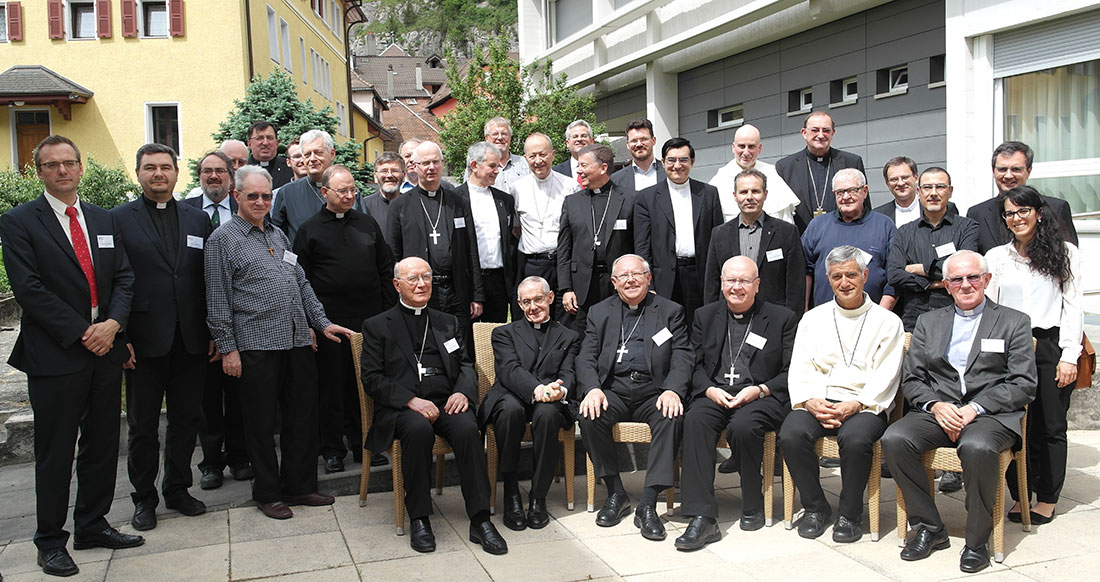
Dialogue isn’t a choice. It’s an imperative to build peace especially today, at a time blemished by conflicts and persecutions carried out in the name of God. And especially in Europe, where winds of radicalization of the Islamic message are sweeping across the cities, attracting young people aged 14-20 in particular. The imperative of dialogue was underlined by the bishops and European delegates responsible for relations with Muslims at the end of an intense colloquium on Islam and radicalization that took place in Saint Maurice, in Switzerland, May 13-15, promoted by CCEE (Council of European Bishops’ Conferences). The appeal of violence. The reality of Islam in Europe is complex. In the past years the number of converts to radicalism has increased, especially among the young. The bishops observe this phenomenon with grave concern owing to its impact on European societies. Radicalized youths that don’t belong to the realm of mosques or Muslim organizations. “Radicalisation – said Olivier Roy, French political scientist at the European University Institute in Florence – is worming its way through the margins of society. But it would be wrong to believe that it is just the consequence of poverty or marginalization. Radicalism is attracts youths by focusing on the allure of violence and sadistic violence”. For this heinous reason ISIS has taken to use the techniques of web communications very skilfully, with the spread of sophisticated videos reproducing beheadings and terrorist actions. For European boys and girls “leaving for Syria is an adventure to brag about.” It is not uncommon to find on Facebook profiles photos of youths armed with Kalashnikovs announcing departures for the “front”. As heroes. Is something changing? How does Islam address this phenomenon? Muslim sociologist Omoro Marungiu-Perria highlighted the urgency for the Muslim world to reflect on its “world view”. The sociologist pointed the finger against “the hegemony paradigm” that unfortunately still characterizes the line of thought of theologians, and preachers. This paradigm excludes otherness and defines Muslim identity with group membership. There is lot of work to be done: the example brought by the sociologist is that of the “charters” adopted by French Muslim community where while it is true that emphasis is placed on “freedom of religion”, “the freedom of conscience, which is the right to choose which direction to give to one’s life and be able to change it”, is completely ignored. But something is changing at grassroots level. There is the hope that the yearning for change may also be felt by the European leadership because Europe needs a modern, European Islam, open to pluralism. Accompanying the debate. The major question is to see how the two trends in Islam – tradition and renewal – will evolve in the future. “As a Catholic Church – said Father Andrea Pacini, coordinator of the CCEE network of Islam – we cannot act or think in place of the Muslims. What Islam is and what it will be is up to them. Our duty is to accompanying this debate efficiently and with concrete actions, with an openness to listen, to dialogue and to interaction”. There is an issue that is very dear to European bishops, which Pacini considers “crucial”. It is the issue of freedom of conscience, namely, the right to choose which direction people want to give to life and change its course. Catholics’ message. The final statement of the bishops to European Catholics is not to surrender to fear. There are many experiences of dialogue ongoing in various European Countries, which show that shared living experiences are possible. In France there are periodical meetings of exchanges and mutual knowledge between priests and Imams. In Bosnia, for years, the Schools for Europe have welcomed students of Catholic, Orthodox and Muslim faith. “The dialogue between Christians and Muslims is necessary not only to create peace. It’s an imperative of our faith”, European bishops write in the declaration published at the end of the meeting. Naturally, fear is justified by the media – and real – images of what is happening in North African countries, and sometimes also in Europe. But it’s also a temptation we should not surrender to because it would be like giving it to its perpetrators. Instead, dialogue is an inner life condition. It is not imposed, but lived. It’s the fundamental precondition to create a Europe of peace, and it will be so only if it will be a home where diversities are not feared but welcomed and respected by everyone like a form of richness.
