CHURCHES IN BRIEF

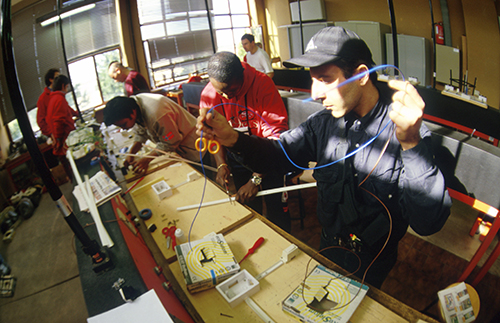
Spain/1: Caritas initiatives to find a job Job placement initiatives are a priority aspect of Caritas activity to provide an answer to the open wound of unemployment. The Report “Caritas and Employment 2014”, presented in Madrid, provides information on the commitment of 70 diocesan Caritas throughout the country in the defence of the right to employment. Thanks to Caritas guidance, 13.681 people have found a job. Caritas secretary general Sebastián Mora, and employment and solidarity employment José Luis Pérez Larios made known that in 70,791 people received targeted advice and guidance for employment through Caritas services and job placement programs across Spain. In addition to sharing their life concerns, a team of 2.619 volunteers and 823 workers supported people who drew close to the job market. For Caritas the fact that 19% of the total number of participants, 3% more compared to 2013, managed to find a job in the past year is a reason for hope. As underlined by Sebastián Mora and José Luis Pérez Larios, for Caritas “it’s important to realise that the job market continues shutting its doors to some groups, notably young people, women, long-term unemployed, over-45 citizens and workers with a low level of education. Spain/2: an X to support the Catholic Church With the motto “There’s a story behind every X”, the Xtantos Programme of the Spanish Bishops’ Conferences invited to bar with an X in favour of the Church in their 2015 tax return statement. The motto reminds taxpayers that their X helps the development of an important commitment for the benefit of society. The Xtantos programme equally underlines that the box in favour of the Church and the one in favour of other social interest goals are perfectly compatible (except in Navarra and in Guipúzcoa), and that therefore both options can be equally ticked. “There’s a story behind every X” is the fil rouge of this year’s campaign presenting the daily life of the Church with posters, pamphlets, billboards, commercials in major radio networks and national television. It shows the work of the Church in six stories: those of Pablo, Juan, Laura and Said, Marina, Joanna and Roberto. Through these characters are presented the daily lives of Christians and non-Christians who draw close to the Church seeking spiritual or social support, in Spain, and beyond national borders. The baptism of Pablo; the life of Juan in and old-age home; Said, integrated in a vocational training centre; Marina lives her faith with other youths in the Way of Santiago; the medicines that Joanna receives in Africa; and Roberto, who receives food in Caritas soup kitchens. The campaign is released on radio, television, billboards, posters for parishes, Facebook and Twitter. Slovakia: exhibition “The Virgin Mary in icons” An exhibition titled “The Virgin Mary in icons” was inaugurated in the diocesan centre of Zilina on May 5 to the presence of Msgr. Tomas Galis, bishop of Zilina, and Miroslav Minarcik, mayor of the city. Until June 5 visitors will have the possibility of admiring over 30 icons and coat-of-arms, inspired to the painters of icons who lived in the XIV-XVII century. During the official inauguration, the two artists Katarina Ksagrandova from Slovakia and Beata Dedecker Vallo from Switzerland – presented their works based on the tradition of the school of Egon Sandler from the Saint George Atelier in France. The exhibition is organized by the institution “Communio” in Zilina, editor of one of the diocesan newspapers and magazines in Slovakia, coordinator of the Week of Christian culture, that traditionally takes place every fall. For further information: www.icommunio.sk. Czech Republic: history students in archbishopric An interesting cooperation between the Archdiocese of Olomouc and the Palacky University of Olomouc was launched a few days ago in the Czech Republic. The agreement was drawn up by the archbishop, Jan Graubner, and by the dean of the university Jaroslav Miller, with the purpose of extending training to history students and enabling them to come into contact with historical events from a practical, not only theoretical, standpoint. The agreement will allow students to visit ecclesial historical buildings, including the archiepiscopal palace, built in the 17th century and to study the books and the precious documents of its library. “Our students should learn more about the archbishopric of Olomouc and its historical background. I believe that our agreement could turn out to be very useful”, Miller said, who also expressed his gratitude towards Msgr. Graubner: “I support 100% the idea of the archbishop of Olomouc, as it equals an openness of the Church to the public”. Msgr. Graubner said he hopes the project will attract the attention of all students: “Today universities offer training and education in many different areas and fields of study, that’s why it’s important to see things from different angles, including the spiritual dimension”.
