FRANCE
Rennes: the Court demands the removal of the statue of John Paul II. The bishop of Ornellas: “Why eliminate symbols that give a meaning to life?” ” “

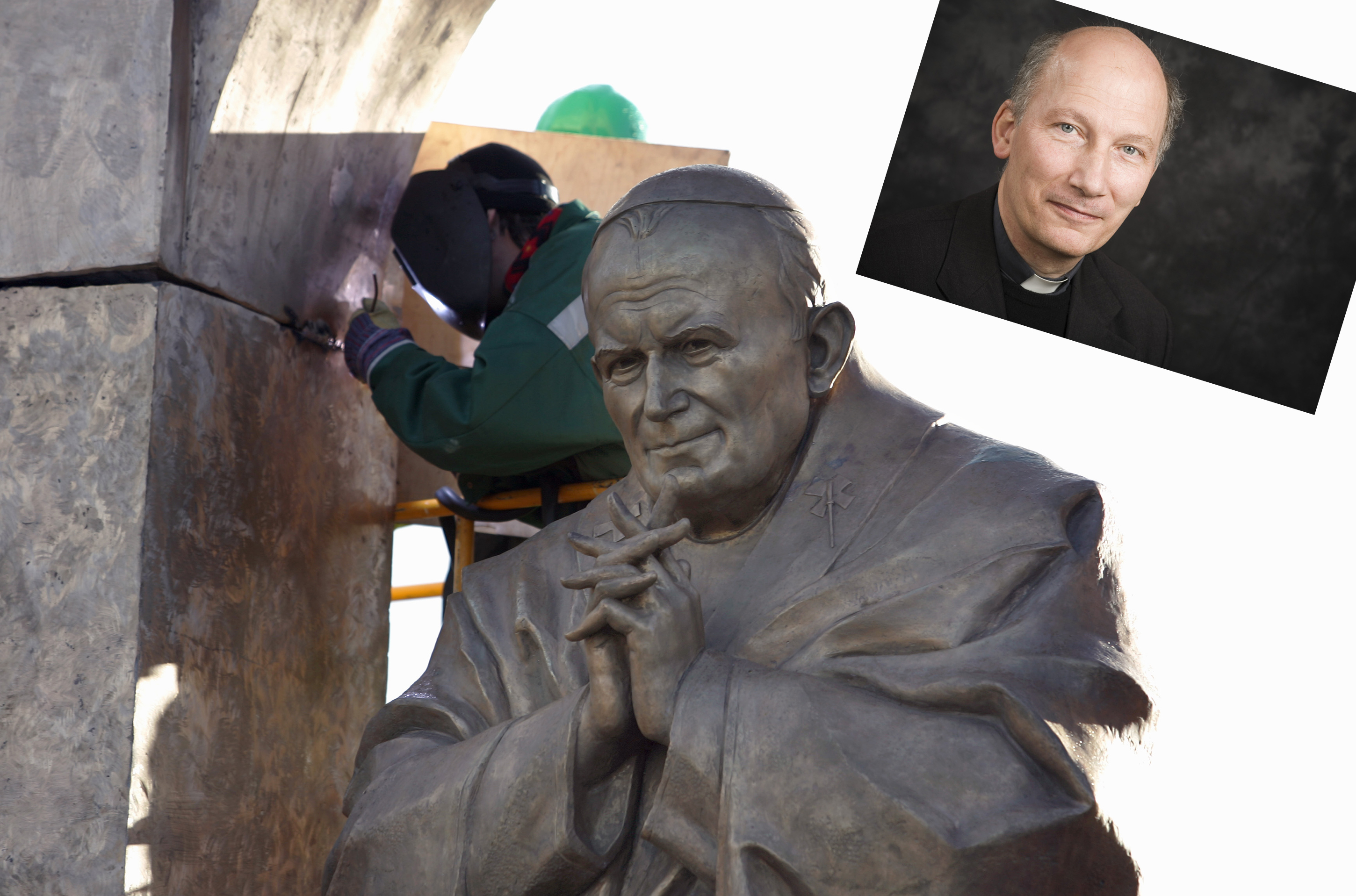
There is no peace for public religious representatives in France. After the sad refusal by the administration of a Paris subway to insert the phrase “in favour of Eastern Christians” on the posters advertising a concert, the proponents of secular thinking focus their attention on a monument celebrating John Paul II installed in the square of Ploërmel, in the department of Morbihan, Bretagne, in 2006. The Administrative Court of Rennes ordered its removal as it “infringes the norms on laicity”. The monument was considered an unlawful “show-off” for its location in the square and for its dimensions, eight-meters height. Monsignor Pierre d’Ornellas is the archbishop of Rennes. He runs a blog on end-of-life themes for the French Bishops’ Conference. He is thus accustomed to debating with everyone. Maria Chiara Biagioni interviewed him for Sir Europe. Your Excellency, what was your reaction when you heard about the Court’s decision? “My feelings were twofold. I had two images in front of me. Here in Europe a rational form of justice removes a statue. There, in the Middle East, statues are destroyed by madness. In both cases, the intention is to eliminate symbols that give meaning to life and are products of artistic talent. My question is: is law made for man? If the answer is yes then its implementation requires human intelligence. It is largely argued that this decision was dictated by blind submission to the law. What does it mean to say that the statue is a “show-off”? Does it refer to its dimension? If that’s the case, then also many crosses and statues of religious figures should be torn down, including the cross over the Hôpital des Invalides in Paris. Does “showing-off” mean proselytism? This definition is equally incomprehensible when there is full respect for the expression of religious belief in the public arena. What is left of a public space open to everyone if transcendence symbols are banned?” This is not the first time that France’s 1905 law on laicity causes strong reactions against the presence of religions in the public domain. The latest was in Paris, with protests against the wording “in favour of Eastern Christians”. What are people are afraid of? “RATP (the company that runs the subway, ed.’s note), refused resorting to a regulation. Why? Isn’t it an evident sign of fear? But fear isn’t a source of intelligence. I’m afraid that some members of society have an irrational fear of religion. By constantly discrediting it for no logical reason, they loose the sense of reality. And reality is man and his quest for transcendence, his commitment as a believer in God, for peace, for the care of the most vulnerable, for service to people living in precarious situations. Authentic religion transmits peace. Those who deliberately discard it in the public arena risk triggering phenomena of extremism and violence. We will regret it. The public arena is not meant to brandish religion but to express and ensure the respect for the freedom of conscience for everyone and in all religious communities. Being afraid of religion, banning it from the public arena, means becoming the accomplices of the terrorist prophets of doom, who make an instrumental use of the name of God without speaking of God. God is neither monstruous nor violent. He is love and tenderness. And everyone’s father”. Thus, laicity. How do French bishops view laicity? “For the hundredth anniversary of the law of 1905, we wrote a document that recognized the value of a peacemaking form of laicity. Created within Judeo-Christian thought, secularism is the result of a history of conflict, that was also fatal. Let us not repeat today the mistakes of our ancestors! We are men and women of peace, able to respect the conscience of others. ‘To respect’ is the verb found in Article 1 of our Constitution. Only respect for the conscience of others and the public expression of the other person’s religion fosters peace. Without doubt, our Muslim friends have entered our French history discovering the beauty of ‘consciousness’ as a sanctuary where God speaks, as a place of freedom, as a space of inner peace. Then Muslims, Christians, Jews, Buddhists and people of good will shall proclaim together that it is good to live in a society where respect for human conscience is the backbone and the condition of a peaceful society”.
