POLAND TO THE POLLS" "
On May 10 Polish voters will elect the new Head of State. Eleven candidates, but the competition is narrowed down to Komorowski and Duda

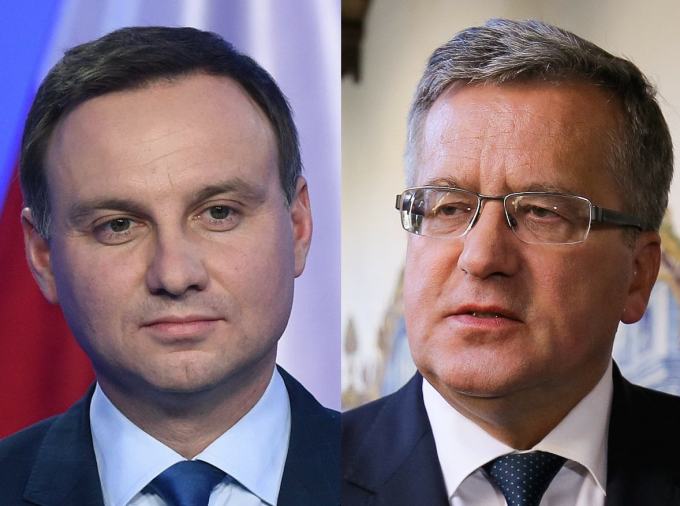
In Poland, among 11 candidates for the presidential election by universal suffrage of Sunday, May 10, the most acclaimed, according to various surveys, are the current president Bronislaw Komorowski, 62, a member of the government’s centrist party Civic Platform (PO), and Andrzej Duda, 42-year old, of the conservative party Law and Justice (PiS). Komorowski ensures the continuity of the current foreign policy, siding with the authorities in Kiev against the annexation of the Crimea and the southeast of Ukraine by Moscow and the social policies of the executive. The themes of the election campaign (a prelude to the renewal of the parliament in Warsaw, in October) include the bureaucratization of public administration, the lowering of the retirement age, increased thresholds for income tax exemption… Some parties highlight the importance of good relations with Moscow and judge negatively the efforts of Poland in favour of the Ukrainian government, stressing instead the need to strengthen relations with other countries of Central and Eastern Europe. The relationship between Poland and the European Union is also an item of debate. As stated by Polish Catholic journalist Piotr Semka, interviewed by Anna Kowalewska for Sir Europe, the Polish bishops obviously “do not take part in the election campaign and do not indicate any choice,” although several members of the Church remind the faithful that in casting their vote for the Presidency of the Republic they should “consider the candidates’ compliance” with “the principles of Catholic faith”. Komorowski was elected president in 2010 as a result of early elections called after the tragic plane crash in Smolensk, where 96 people died, including the then president-in-office Lech Kaczynski. Since then his competitor has been the twin brother of the late President, Jaroslaw Kaczynski. Why is PIS presenting a different candidate? “The Poles are tired of the conflict owing to the causes, yet unclear, of the Smolensk tragedy that caused a deep rift in the Country. Thus PiS decided to renew its image and Duda can play an important political role overcoming the divisions of Smolensk”. Both major candidates refer to Christian values. But president Komorowski, despite the critical opinion of the episcopate, has recently signed the Law ratifying the Convention of the Council of Europe on the prevention and fight on violence against women and domestic violence (Cahvio), that is considered influenced by “gender” ideology. Instead Duda, reaffirming the role of Catholicism in the history of Poland, declared that he intends to “fight against the implementation of models that go against the national tradition in the Polish legal system, seeking to replace it”. Do the two candidates have different opinions regarding the ratification of the Convention of Istanbul? “Poland is a Catholic country, and therefore the presidential candidates do not criticize the Church. In the election campaign Komorowski has often emphasized his ties with the Church but, in contrast to the opinion of the bishops, he supports for example the government measures related to refinancing by the National Health System of assisted reproduction procedures. Andrzej Duda, however, refers the decision on the submission of the bill without prejudging the outcome of the parliamentary debate nor the judgment of public opinion”. In which ways does the current election campaign differ from the previous ones? “In this election campaign have made their appearance protest candidates that divide the political spectrum in ‘them’ – that is, the politicians of the major parties who “share the loot” – and ‘us’, i.e., the representatives of the man on the street. One of these protest candidates is Pawel Kukiz, a showman capable of stirring the applause of the crowd without even presenting a real political program. Another candidate is Janusz Korwin Mikke. In the parliamentary elections planned for the coming fall he could even become the leader of the third party on a national scale. Mikke, who is gaining increasing consensus in the polls, for the first time in the history of Poland nonchalantly declared that his children have different mothers. This shows that a new electorate is emerging in Poland, ever more liberal, that whilst supporting conservative ideas is capable of accepting a model of life distant from Church teaching. Magdalena Ogorek, the candidate of the democratic Left, said nothing worthy of note during the election campaign, thus her party risks being left without a parliament seat in the national elections of the coming fall”.
